
Every meth warning-sign list you have ever read describes the same house. Yellow stains, blacked-out windows, dead grass out the back. That house is real. It is also the minority of contaminated properties in Australia, and the ones that actually catch people out look completely ordinary.
This covers the ten forensic markers an environmental hygienist notes on a walkthrough, what each one tells you about how bad the contamination is likely to be, and the far more common scenario that leaves no markers at all.
Key takeaways
- The visible signs of a former meth lab all come from manufacturing. Yellow iodine staining, reddish burns near sinks, stripped plumbing, dead patches of lawn. These are cook signs, and they only appear in a minority of contaminated properties.
- Smoking leaves no signs at all. No stains, no glassware, no dead grass. Australia’s enHealth guidance estimates thousands of people are exposed through detected and undetected clan labs, and tens of thousands through residue left by smoking crystal meth. The bigger problem is the invisible one.
- The threshold is 0.5 µg per 100cm². Above that, a property is contaminated under the national remediation guidelines, whether the meth was cooked there or smoked there.
- A checklist cannot clear a house. Only a laboratory can. Warning signs tell you when to test. They never tell you a property is safe.
- Air conditioning and ceiling exhausts hold the highest readings in most contaminated homes, because they redistributed the residue while it was being made.
What are the signs of a former meth lab?
The signs of a former meth lab are chemical stains and burns on benches, sinks and drains; yellow-brown iodine discolouration on walls and ceilings; modified plumbing and improvised ventilation; discarded pseudoephedrine packets, lithium battery casings, gas cylinders and laboratory glassware; dead vegetation where waste was tipped; and blacked-out or reinforced windows. Any one of them is a reason to test, not a diagnosis.
That last sentence is the one most people skip. Hold onto it.
Most meth house warning signs lists are describing a house from 2010
Here is the problem with almost everything written on this topic.
The classic warning-sign list, the one you have already read four versions of, describes a red phosphorus cook or a Birch reduction happening in a suburban kitchen. Those methods leave dramatic evidence, because they involve iodine, red phosphorus, anhydrous ammonia, lithium stripped out of batteries and a lot of corrosive vapour with nowhere to go.
That evidence is real. The national Clandestine Drug Laboratory Remediation Guidelines name the chemicals for both routes: hypophosphorous, phosphorous and phosphoric acids plus iodine, iodide salts and red phosphorus for the first; condensed anhydrous ammonia with lithium, sodium or potassium for the second. Cook a batch and the house wears it.
But most contaminated Australian properties were never labs.
They were rentals where someone smoked. And smoking leaves you nothing to look at. No stains. No burnt-out fan. No dead grass. Just methylamphetamine salts settling into plasterboard, carpet backing, curtains and the inside of the ducting, quietly, for however long the tenancy ran.
So you get the situation that catches buyers and landlords out: a house that passes every visual inspection on the internet, and fails a swab.
Common belief: you can spot a meth house.
Reality: you can sometimes spot a former meth lab. Contamination is a different question, and it is mostly invisible.
Why it matters: if you are relying on your eyes and nose to decide whether to test, you will only ever catch the loud cases.
The forensic markers: what to look for, and what each one means
These are the specific things an environmental hygienist notes on a walkthrough, grouped by what caused them. The cause is what tells you how bad it is likely to be.
Yellow to brown staining on walls, ceilings and door frames
Iodine-based synthesis throws aerosol into the room. It settles, and it darkens. The remediation guidelines describe deposits developing a pale yellow to strong brown colour over time as iodine is liberated. Look at the top corners of rooms, above door frames, and on ceilings near where a bench or stove sat.
The guidelines set a separate action level for iodine of 22 µg per 100cm², which tells you regulators treat it as a contaminant in its own right, not just a marker.
Important caveat, straight from the same document: many byproducts stay visually undetectable. A clean-looking wall proves nothing.
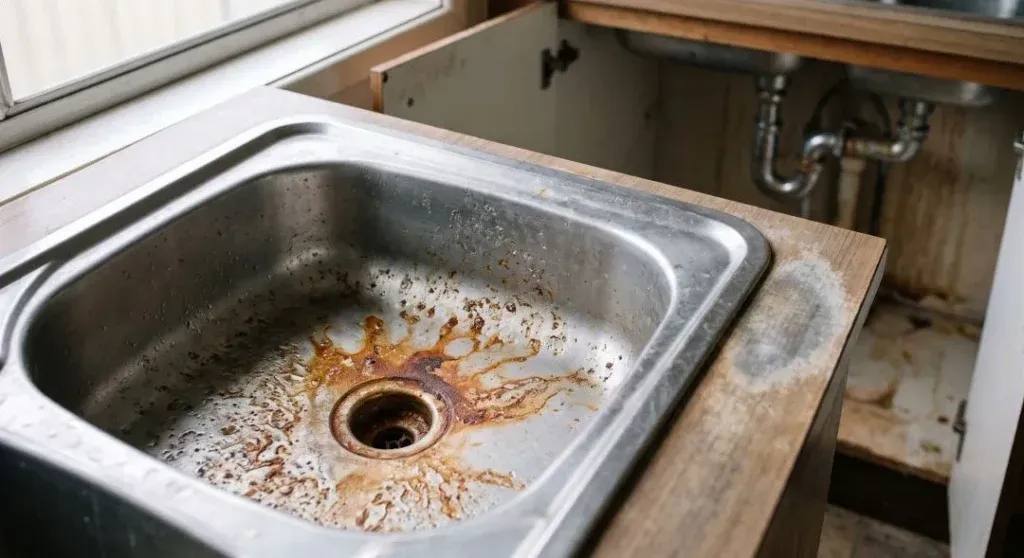
Reddish or rust-coloured staining around sinks, drains and baths
Red phosphorus residue and acid waste both leave this. Cooks pour waste down whatever drain is closest. Check under the vanity, around the laundry trough, at the shower waste, and at the external gully trap.
The assessment checklist in the national guidelines specifically flags staining around drains and corrosion and staining on fixtures, walls and bench surfaces consistent with chemical exposure. Rust on a stainless steel sink in a house with no rust anywhere else is not a coincidence.
Etching, clouding or burn marks on glass and benchtops
Hydrogen chloride gassing pits and clouds glass. Look at window panes near where cooking would have happened, glass shelving, mirrors and the splashback. Laminate benchtops show pale bleached rings and burn scars where hot glassware sat.
Plumbing that has been altered for no domestic reason
One of the most reliable structural markers, and one of the most commonly missed. Cooks reroute waste to avoid a trap, cut in extra taps to feed a condenser, or bypass sections entirely. Under-sink pipework that has been cut and rejoined in a house with no plumbing history is worth a question.
Corroded traps and stripped chrome on the underside of fittings point the same way.
Improvised ventilation
Extraction a builder would never install. A hole cut through a wall or ceiling for flexible ducting. A bathroom exhaust fan mounted in a bedroom window. Ducting running out a window and taped in place. Kitchen or bathroom fans replaced with something oversized.
The guidelines list internal or improvised air ducting as a checklist item, and discolouration of extraction fans, filters and vents as visible evidence.
Here is the part people underestimate. enHealth notes that air conditioning and room ventilation are associated with significant spread of contamination through a home, and that fans and air conditioning systems commonly carry the highest contamination levels on site. The ventilation is not just a clue. It is often the worst-affected asset in the building.
Waste that does not belong in a house
What turns up in yards, under houses, in wheelie bins and in ceiling cavities:
- Empty pseudoephedrine and cold and flu packets in volume, often pressed out and flattened
- Lithium battery casings, split lengthways, usually with the lithium strip gone
- Gas cylinders and butane fuel cans, sometimes with corroded or discoloured brass fittings
- Anhydrous ammonia in improvised storage: LPG bottles, fire extinguishers, esky-packed containers, all with blue-green corrosion at the valve
- Stained coffee filters, cheesecloth or pillowcases used for filtering
- Improvised chemical apparatus: laboratory glassware, pyrex jugs, tubing, pH strips and testers
- Solvent containers well beyond household quantities: acetone, methylated spirits, toluene, drain cleaner, caustic soda
Queensland Police list improvised heating and cooling mechanisms, laboratory glassware, gas cylinders or butane cans, pH testers, cold and flu medicine packets and stained coffee filters among the indicators of a suspected drug lab.
Dead vegetation, bare soil and stained concrete
Waste gets tipped. Where it lands, things die and do not come back. The guidelines list bare patches, visible staining, unexplained disturbance or dead vegetation in soil as assessment indicators.
On hard surfaces, look for pale bleached patches on driveways and paths, and dark chemical spills on garage or shed concrete. A burn pit or a scorched patch in a back corner is common too, because burning waste is easier than disposing of it.
Blacked-out windows, and security that does not match the house
Painted, foiled, boarded or permanently covered windows. Queensland Police name blackened, covered or reinforced windows directly. Alongside that: deadbolts on internal doors, cameras covering approaches rather than entrances, reinforced door frames, dogs kept for warning rather than company.
Then the concealment work. Hidden compartments in walls, a floor cavity with a cut hatch, a false back in a wardrobe, a sealed roof space with a new access panel. These usually surface during a strip-out rather than a walkthrough, but if you see fresh, unexplained carpentry, look closer.
Two behavioural patterns worth adding, both from the police list: frequent chemical deliveries arriving at a residential address, and rubbish that never goes out or gets burnt on site. Combine either with severe property neglect, a house left to fall apart while someone is clearly living in it, and you have enough to justify a test.
Odour that is not a household odour
The smells reported most often are a sweet ammonia sharpness, a cat urine odour in a house with no cat, and a persistent solvent note that reappears on warm days.
That last detail is the useful one. enHealth explains the mechanism: methylamphetamine absorbed into porous materials like gypsum plasterboard, what most people call drywall, desorbs over time, releasing contamination back into the air. Heat drives it. A lingering chemical odour that comes and goes with the weather in a closed-up house is not your imagination, it is off-gassing.
Worth separating two things that get muddled. During an active cook, the hazard is volatile organic compounds and acid gases coming off solvents and reagents in real time. In a former lab that has long since dispersed. What remains is deposited residue, which is a contact and dust problem rather than a fume problem, right up until someone sands, scrapes or renovates and puts it back into the air.
Absence of smell means nothing. Most contaminated properties smell like nothing at all.
People in the house getting sick without explanation
The last marker is the occupants. Queensland Health lists throat irritation, breathing difficulties, headaches, skin conditions and mental health problems as possible symptoms of exposure to a former illicit drug laboratory, and notes that adverse effects are mainly related to long-term rather than short-term exposure.
Unexplained respiratory irritation, rashes on hands and forearms, headaches that clear when the family goes away for a week and return within days of coming home. On their own these mean very little. In a house carrying any of the other nine markers, they matter.
Children are the ones to watch. enHealth identifies children aged six months to two years as the highest-risk group, because of contact time with the floor and hand-to-mouth behaviour. That is the third-hand exposure pathway: not the drug, not the smoke, the residue left behind.
Cooking versus smoking: two problems, one test result
Both breach the same threshold. Almost nothing else about them is the same.
| Manufacture (clan lab) | Smoking / heavy use | |
|---|---|---|
| Visible evidence | Staining, burns, altered plumbing, improvised ducting, chemical waste | Usually none |
| Contaminants | Methylamphetamine plus iodine, phosphine, hydrogen chloride, solvents, heavy metals | Methylamphetamine residue, largely on its own |
| Where it concentrates | Cook room, drains, exhaust paths, soil, waste dump points | Living areas, soft furnishings, ceiling and wall surfaces, ducting |
| Structural risk | Real. Fire damage, corrosion, spills into subfloor and slab | Rare |
| Typical remediation | Strip-out of porous materials, sealing, staged clearance | Cleaning, sometimes sealing, targeted replacement |
| How it is usually found | Police action, or a buyer who noticed something | A routine or pre-purchase test |
| How common | Less common | Far more common |
The practical consequence: the property with no warning signs is the one that most often surprises people. A cook site announces itself. A five-year smoking tenancy does not, and it can still land well above the limit.
The number that actually decides it: 0.5 µg per 100cm²
Australia applies a health investigation level of 0.5 micrograms of methylamphetamine per 100 square centimetres of surface. Above it, a property is treated as contaminated and requires remediation. Below it, after a valid clearance, it is considered fit for occupancy.
The number is unforgiving in a way that surprises owners. enHealth reports health effects associated with contamination between 0.01 and 42 µg per 100cm², and average levels in affected homes of 5.8 to 18.6 µg per 100cm², roughly ten to forty times the guideline.
So the failures are rarely marginal. When a property fails, it usually fails by an order of magnitude.
No visual inspection can produce this number. That is the whole point of it.
Where the residue actually goes
Understanding this changes how you inspect, and how you budget. Methylamphetamine deposits as salts on hard and porous surfaces. Hard surfaces can usually be cleaned. Porous ones hold it, and give it back.
Plasterboard
Absorbs residue and releases it back into the air over months and years.
HVAC ductwork and fans
Frequently carry the highest readings in the building. Almost always missed by a clean.
Carpet and underlay
Retains residue deep in the backing, well past what a steam clean reaches.
Timber, grout, concrete
Unsealed surfaces hold residue in the top layer. Cornice and skirting too.
Ceiling insulation
Collects residue and is almost never salvageable. Budget to replace it.
Before anyone picks up a scraper: enHealth warns that disturbing contaminated material during cleaning or renovation can regenerate an inhalation hazard, with particles under 0.1 micrometres capable of deep lung penetration. Renovating a contaminated house without testing it first is the single most common way people turn a chemical problem into a health problem.
If you want the full remediation sequence, testing through to clearance, that is covered in our guide to meth decontamination in Australia.
Testing: what each option can and cannot tell you
| Method | What it gives you | Where it fails |
|---|---|---|
| DIY test kit | A yes/no presence screen on one spot, same day, low cost | No concentration figure, no sampling design, no legal standing. Reads positive on trace levels well under the limit, and can miss contamination two metres away |
| Composite screening test | One combined result across several rooms. A good, cheap first pass | Averaging hides a single very hot room |
| Discrete surface sampling | Room-by-room concentrations against 0.5 µg/100cm², NATA-accredited laboratory analysis | Costs more, takes days |
| Baseline swabbing at lease start | A dated record proving the condition when the tenancy began | Only useful if you did it before, not after |
| Full hygienist assessment | Sampling plan, contamination mapping, remediation scope, clearance criteria | Overkill for a simple screen |
In Queensland, Forensic and Scientific Services provides sampling kits and accredited laboratory testing, and either party to a tenancy can engage a commercial testing company.
A note landlords keep learning the hard way: baseline swabbing at the start of a tenancy is the only thing that reliably establishes who caused the contamination. Test after the fact and you have a result with no timeline attached. That is a weak position at a tribunal, and a weak position with an insurer.
Post-tenancy screening is the other half of that pair, and it is cheap. A composite screen at vacate, before the bond is released, costs less than a carpet clean and settles arguments before they start.
Buying, renting and disclosure
Disclosure law is not consistent across Australia, and where it is silent the risk lands on the buyer or the owner.
Queensland’s Residential Tenancies Authority is direct about it: the Act does not specifically require drug contamination to be disclosed, though both parties are expected to raise concerns as soon as they have them. Lessors must still ensure premises are fit to live in and in good repair, and where contamination is confirmed at unsafe levels the owner carries the remediation cost and must comply with any public health order.
What actually protects you
- Buyers: arrange pre-purchase meth testing as a separate engagement. Building and pest does not cover it.
- Landlords: baseline swab at the start of every tenancy, screen at vacate.
- Sellers: a clearance certificate from an accredited laboratory is an asset at contract stage.
- Everyone: read the insurance wording before you assume you are covered.
What does not protect you
- A building and pest inspection. It does not test for methamphetamine.
- An entry condition report. Useless for establishing contamination.
- A vendor’s reassurance with no laboratory result behind it.
- A DIY kit result. It has no standing with an insurer, tribunal or buyer.
- Assuming a policy covers it. Most treat contamination as gradual damage, not a sudden event.
Two things buyers ask about constantly. First, police-seized properties. Where a lab has been dismantled by police, a local government public health order can attach to the property, and remediation to the guideline plus clearance is what lifts it. Some councils and state health departments keep records of properties subject to such orders, so make a direct enquiry to the relevant local government before you sign rather than relying on a national register, which does not exist.
Second, value. A confirmed history knocks a property’s price, and the discount is usually larger than the remediation cost. That gap is where the opportunity sits for buyers with a clearance certificate in hand and the nerve to use it.
One correction while we are here. Australia does not run a zero-tolerance standard. A detectable trace is not automatically a contaminated property. The standard is a threshold, and the threshold is 0.5.
Contamination also does not stop at a property line. In apartment buildings and unit blocks it moves through shared ducting, wall cavities and common areas, which is exactly what we found across a twelve unit apartment block where testing and clearance had to be run unit by unit.
Vehicles are their own category. Camper vans, caravans, trucks and cars get used both for cooking and for use, and a sealed cabin concentrates residue in a way a house does not. Meth cleaning in vehicles covers how testing and decontamination differ there.
If you think you have found an active lab, stop
This part is not negotiable.
Do not enter. Do not touch containers. Do not turn lights or fans on or off, because switches spark and clan lab atmospheres can be flammable. Do not open anything sealed. Leave, get upwind, and call 000.
Queensland Police maintain a page on what to do if you suspect a drug lab, including the behavioural indicators landlords report most often: rent paid months ahead in cash, applicants avoiding background checks, rubbish never put out or burnt on site, and heavy traffic at odd hours in a property that looks empty during the day.
An inactive site is a different risk. It is a chemical residue problem, not a fire and gas problem, but the personal protective equipment still matters: P2 respirator, disposable coveralls, gloves, eye protection, and ventilation before entry. Queensland Health’s guidance on illicit drug laboratories sets out that minimum.
Hazardous waste from a former lab is not general waste. It is a licensed disposal stream, and putting it in a skip creates a second problem.
What happens after a positive result
Short version, because the meth decontamination process deserves its own read.
Assessment
Sampling plan, contamination mapping, scope of works.
Removal
Porous materials that cannot be brought under the limit come out. Carpet, underlay, insulation, sometimes plasterboard and cabinetry.
Cleaning
Staged wash-down of remaining surfaces, top down, with waste captured rather than spread.
Ventilation systems
Ducting cleaned or replaced, filters discarded, units assessed.
Sealing or encapsulation
Where a surface stays but will not come down to the limit by washing, it gets stripped back or sealed. On walls that usually means removing old paint layers holding residue, then encapsulating with a purpose-made sealer so nothing desorbs back into the air.
Clearance testing

Independent post-remediation sampling against 0.5 µg/100cm², producing a certificate.
Step six is the one that matters legally and commercially. A clean without clearance testing is a story, not a result. If a quote does not include independent clearance sampling, it is not a decontamination quote.
Where a site also involves biological material, structural fire damage or a police scene, the work sits alongside forensic cleaning and broader chemical decontamination rather than replacing them.
How to choose a remediation company
Four questions. They separate real operators from carpet cleaners with a new service page.
1. Who does your clearance testing?
The right answer is an independent NATA-accredited laboratory, not the remediation contractor.
2. What guideline are you working to?
The national clandestine drug laboratory remediation guidelines, plus relevant state guidance. Ask them to name it.
3. What is your scope if the ducting fails?
If they have not thought about the HVAC, they have not read the research.
4. What does your waste chain look like?
Licensed hazardous waste disposal, with documentation.
If the quote is a flat number with no testing stage in front of it, they are guessing. Anyone can guess more cheaply than a laboratory can measure.
Frequently asked questions
How can you tell if a house was a meth lab?
You cannot tell for certain by looking. Cook sites usually leave physical evidence: yellow-brown iodine staining, corrosion around sinks and drains, altered plumbing, improvised ventilation, chemical waste and dead vegetation. Properties contaminated by smoking leave no visible evidence at all. Laboratory surface testing against the 0.5 µg/100cm² threshold is the only way to confirm it.
Are DIY meth test kits accurate?
They are a presence screen, not a measurement. A DIY kit can tell you methamphetamine is on a surface, but it does not give a concentration, does not follow a sampling design, and has no standing with an insurer, tribunal or buyer. Use one to decide whether to book accredited testing, never to clear a property.
Can meth residue make you sick years later?
Yes. Queensland Health notes contamination can remain in structures for many years, with adverse effects mainly linked to long-term exposure. Reported symptoms include throat irritation, breathing difficulties, headaches and skin conditions. Residue absorbed into plasterboard and ducting can release back into indoor air over time.
Does a normal building inspection test for meth?
No. Standard building and pest inspections do not test for methamphetamine contamination. Pre-purchase meth testing is a separate service and must be arranged specifically, usually as a condition of the contract.
Does a house have to be demolished if it was a meth lab?
Almost never. Most contaminated properties are remediated by removing porous materials, cleaning and sealing what remains, addressing the ventilation system, then passing independent clearance testing. Demolition is reserved for extreme structural or fire damage, not contamination alone.
Who pays for meth decontamination in a rental?
It depends on when the contamination occurred and what can be proven. Where the property owner is responsible for premises being fit to live in, remediation cost generally sits with them. Where a tenant caused the damage, recovery is possible but usually requires a baseline test from the start of the tenancy. Without a baseline, proving timing is difficult.
The bottom line
Warning signs are a trigger, not a verdict.
If you can see yellow staining, corroded drains, spliced plumbing, a fan cut into a bedroom window, split battery casings in the yard or a dead patch of lawn that nothing will grow on, you are almost certainly looking at a former cook site, and it needs a hygienist before it needs anything else.
If you can see none of that, you have ruled out almost nothing. The most common contaminated property in Australia looks completely ordinary, which is exactly why it keeps getting sold, leased and renovated by people who had no idea.
Test before you buy. Baseline before you lease. And never let anyone clean a property without telling you what the clearance number came back as.
Think you need this checked? AllAces provides methamphetamine testing and decontamination across Queensland, New South Wales and Victoria, with independent laboratory clearance on every job.
Meth decontamination services | The full decontamination guide
Sources: enHealth Guidance on Clandestine Drug Laboratories and Public Health Risks; Commonwealth Clandestine Drug Laboratory Remediation Guidelines; Queensland Health; Queensland Police Service; Residential Tenancies Authority Queensland. Last reviewed September 2026.