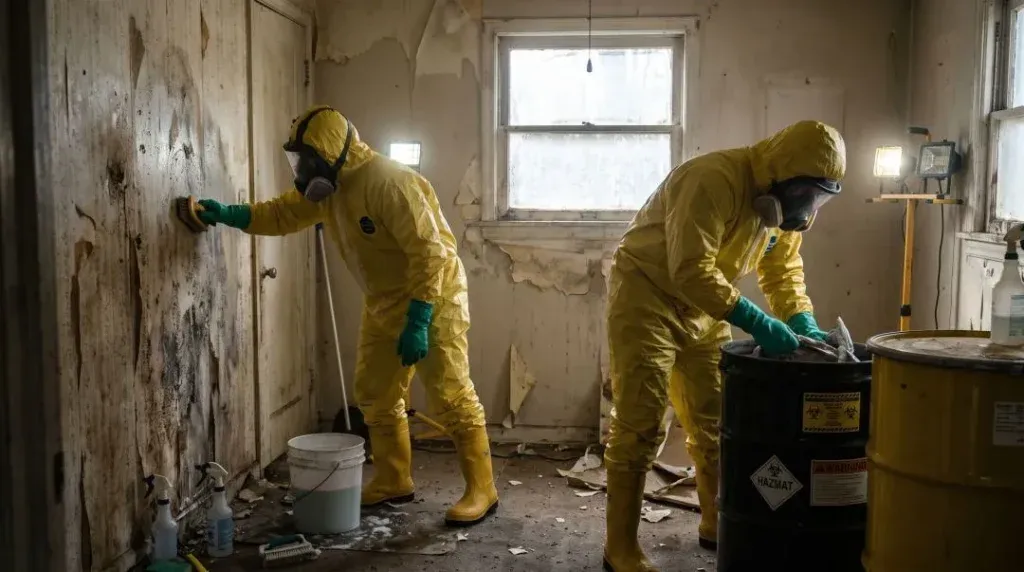
A former meth lab is the hardest kind of meth job there is. Cooking leaves far more residue than smoking does, plus a list of chemicals a standard methamphetamine swab doesn’t even look for. Cleaning one up takes longer, costs more and needs a clearance result at the end that will satisfy a council, a buyer or an insurer.
This guide covers what a meth lab clean-up involves, who is responsible for it, how long it takes and how to choose who does the work.
A meth lab clean-up is the decontamination of a property where methamphetamine was manufactured. Contaminated materials are removed, the remaining surfaces and ventilation are treated, and independent testing confirms every surface is back under 0.5 micrograms per 100cm². Until that clearance result exists, the property isn’t clean.
Key takeaways
- Labs read far higher. A former lab typically reads 10 to 100 µg/100cm² or more, against about 2.7 for a house where meth was only smoked.
- More than meth. Labs leave precursor chemicals as well as methamphetamine, so testing and clean-up both go wider.
- Councils can order it. In Queensland a former lab site is a prescribed public health risk, and a council can order the owner to clean it up.
- Two to four weeks. Most lab jobs take two to four weeks end to end, including two rounds of laboratory testing.
- Clearance is the deliverable. The clearance test at the end is what lifts a public health order and makes the property saleable again.
Why a meth lab is a bigger job than smoking residue
Smoking leaves methamphetamine residue on surfaces, and on its own that’s usually enough to fail a test. WA Health puts the average from smoking at around 2.7 µg/100cm², already more than five times the limit. Manufacture is a different scale. Readings of 10 to 100 and beyond are common, and the residue comes with acids, iodine, phosphorus compounds and solvents that a standard methamphetamine wipe doesn’t measure.
Cooking also moves contamination further. Venting, spills and improvised ducting put residue into the roof space, the subfloor and the plumbing, well beyond the rooms that look affected. That’s why a lab job’s testing, scope and clearance all cover more of the building.
If you’re not sure whether a property was a lab or just used, start with the signs of a former meth lab. For contamination from smoking, see meth contamination in Australian property.
Who is responsible for cleaning up a meth lab
Police deal with the active lab, the chemicals and the equipment. Once that’s done, the property goes back to its owner, and the owner is responsible for the clean-up.
Please note: this is general information, not legal advice. Check with your council or a solicitor before relying on it.
How a meth lab is cleaned up, stage by stage
A sampling plan, contamination mapping and a scope of works. On a former lab, meth lab testing goes beyond methamphetamine to the precursor chemicals, and sampling extends to the roof space, the subfloor and the drains.
The work area is sealed and put under negative pressure, so residue disturbed during the clean doesn’t spread to clean parts of the building or next door.
Porous materials that can’t be brought under the limit come out: carpet, underlay, insulation, and on most lab jobs plasterboard and cabinetry as well. Everything goes out as regulated waste, with disposal dockets.
A staged wash-down of every remaining surface, top down, with waste captured rather than spread. On lab jobs this usually runs more than one cycle.
Ducting is cleaned or replaced, filters are discarded and units are assessed. Exhaust fans and rangehoods are included, because they drew contaminated air through.
Where a surface stays but won’t come down to the limit by washing, it’s stripped back or sealed with a purpose-made encapsulant, so nothing releases back into the air.
Independent post-remediation sampling against 0.5 µg/100cm², producing a clearance certificate.

Stage seven is the one that matters legally and commercially. A clean without clearance testing is a story, not a result. If a quote doesn’t include clearance sampling, it isn’t a meth lab clean-up quote.
How each stage runs on site is covered in more depth in the meth decontamination process.
How long a meth lab clean-up takes
The crew is quick. The laboratory isn’t, and there are two rounds of it, one before the clean and one after. Most former lab jobs take two to four weeks from first test to clearance certificate.
What a meth lab clean-up costs
Former labs sit at the top end of meth decontamination costs. As an estimate, most lab jobs run $10,000 to $40,000 or more, and the final figure depends on how severe the contamination is: how high the readings are, how far the residue spread, how much has to be stripped out, and whether the ventilation system can be cleaned or has to be replaced.
Nobody can quote this honestly without a test result. A flat price over the phone is a guess. How a real meth decontamination quote is built, line by line, is in what meth decontamination costs.
Choosing who does the clean-up
Nobody licenses this work in Australia, so the vetting is on you. Four questions separate real operators from carpet cleaners with a new service page.
1. Who does your clearance testing?
Ask whether you can use an independent assessor, and which NATA accredited laboratory analyses the samples.
2. What guideline are you working to?
The national clandestine drug laboratory remediation guidelines, plus relevant state guidance. Ask them to name it.
3. What’s your scope if the ducting fails?
If they haven’t thought about the HVAC, they haven’t read the research.
4. What does your waste chain look like?
Licensed hazardous waste disposal, with documentation.
If the quote is a flat number with no testing stage in front of it, they’re guessing. More on reading a quote in how to compare meth removal quotes.
Getting a public health order lifted
Where police have dismantled a lab, a council can attach a public health order to the property. The order stays until the owner shows the property has been cleaned to the guideline. In practice, that means the clearance report: the sampling plan, the laboratory results showing every surface under 0.5 µg/100cm², waste disposal dockets and the clearance certificate. Send the council the full package, not just the certificate, and keep a copy permanently. It protects you at the next lease, the next sale and the next dispute.
Frequently asked questions
How long does a meth lab clean-up take?
Usually two to four weeks from the first test to the clearance certificate. Strip-out and washing on a former lab can each take anywhere from three days to two weeks, and the laboratory adds three to five business days at each end.
Can anyone live in the house during a meth lab clean-up?
No. The property is vacated from containment through to clearance. In Queensland, a property under a public health order generally stays vacant until the clean-up is finished.
Who pays for a meth lab clean-up in a rental?
Generally the owner, who is responsible for the premises being fit to live in. Some landlord insurance policies respond to it, many exclude illicit drug contamination, and nearly all require prompt notification.
Is a meth lab clean-up the same as meth decontamination?
It’s the most serious kind of meth decontamination. The stages are the same, but a former lab adds precursor chemicals, higher readings and a wider spread, so testing, strip-out and clearance all go further.
Does a former meth lab have to be demolished?
Almost never. Demolition only comes up on long-running labs where chemicals have soaked into the framing, and even then it’s the exception.
Is drug lab cleanup only for meth labs?
No. The national clandestine drug laboratory guidelines cover labs making other drugs too, such as MDMA or GHB, and the clean-up follows the same pattern: test, remove, wash, clear. Meth is just the drug most Australian labs make, which is why most people search for meth lab cleaning. What changes with other drugs is the chemical panel the laboratory runs, so tell the tester what’s suspected.
Talk to an expert
Dealing with a former meth lab? AllAces has been doing decontamination work in Australia for more than 35 years across more than 65,000 jobs, as an IICRC Certified Firm with 24/7 response in Brisbane, Sydney, Melbourne and Ballarat. Call 1800 00 10 10.
Book meth testing to find out where you stand, or talk to us about meth decontamination services.
How this guide was put together
Written by David Spencer, AllAces’ Methamphetamine Decontamination Technician. Reviewed by Marc Christie.
AllAces Cleaning & Restoration has operated in Australia for over 35 years as an IICRC Certified Firm, with more than 65,000 jobs completed. Last reviewed October 2026. Next review April 2027.