Every meth decontamination company in Australia describes itself as certified. Very few of them explain what the word is doing in that sentence, and there is a reason for that.
There is no licence for meth decontamination in this country. No trade registration, no national accreditation scheme, no Australian Standard. Peer-reviewed Australian research put it plainly in 2021: there is currently no legislation or regulation for meth remediation, and the industry has no mandatory training nor standardised techniques.
That is not a reason to panic, and it is definitely not a reason to do it yourself. It is a reason to know exactly which credential covers which part of the job, because the word “certified” is doing very different work depending on who is saying it.
Key takeaways
- NATA accredits the laboratory, not the company that cleaned your house. It covers the analysis of the sample, against a defined scope of accreditation.
- A NATA logo on a report does not certify everything in that report. NATA's own emblem rules forbid implying accreditation for a service not on scope.
- There is no IICRC certification for meth decontamination. Providers advertising one are borrowing adjacent credentials such as trauma or microbial remediation.
- Standards Australia has adopted IICRC standards for water damage and mould, but not for meth. What exists for meth is a 2011 Commonwealth guideline and a voluntary industry code.
- 76% of Australian operators surveyed offered both testing and remediation. The researchers recommended those stages be separate companies.
- SA Health uses the word independent for the assessor. WA Health structurally separates the testing contractor from the cleaning contractor.
- 0.5 micrograms per 100cm2 is the number. Everything above is contaminated. Iodine has its own limit at 22 micrograms per 100cm2.
What does "certified meth decontamination" actually mean in Australia?
It has no single legal meaning. Australia has no licence or registration scheme for meth decontamination contractors. What can be verified is narrower and more useful: whether the analysing laboratory holds NATA accreditation to ISO/IEC 17025 for that test, whether the assessor holds a recognised professional certification such as the AIOH’s Certified Occupational Hygienist, and whether the work follows the Commonwealth remediation guidelines.

The uncomfortable starting point: nobody licenses this work
A 2021 study in the International Journal of Environmental Research and Public Health, led by researchers at Flinders University, surveyed the Australian methamphetamine testing and decontamination industry. Its finding was blunt: there is currently no legislation or regulation for meth remediation, and the industry has no mandatory training nor standardised techniques.
Flinders’ own summary added the detail that stings: because the guidelines are broad, business owners must establish and interpret which techniques and chemicals are most effective. Researcher Dr Kirstin Ross made the comparison that lands hardest: you would not let an unregulated tradie do your wiring, so it is worth asking why an unregulated person is spraying chemicals through your house.
Checked against state licensing registers, that holds. The QBCC’s published licence classes in Queensland cover plumbing, drainage and mechanical services occupations. None covers decontamination, drug residue or hazardous materials remediation. NSW’s categories of building and trade work list specialist and trade categories in detail, and none of them covers this either.
What does exist is a voluntary code of practice published by Environmental Health Australia for assessment, remediation and validation of former clandestine drug laboratories. Voluntary is in the title.
Common belief: “certified” means a regulator has approved this company.
Reality: in meth decontamination there is no regulator issuing that approval. The verifiable credentials sit with the laboratory and with individual professionals, not with the contractor as a business.
Why it matters: it changes what you ask for. Not “are you certified”, but “certified by whom, for what, and can I look it up”.
NATA accreditation: what it covers, and what it does not
This is the credential that carries real weight, and it is also the one most often stretched.
The National Association of Testing Authorities accredits laboratories to ISO/IEC 17025. NATA assesses method validity, staff competency, traceability of measurement, equipment calibration and quality control, and the accreditation applies to the specific methods listed on that laboratory’s scope of accreditation.
What NATA accreditation covers
- The laboratory that analyses your swab
- The specific test methods listed on its scope
- Traceability of the measurement to national and international standards
- Quality control around the analysis
What it does not cover
- The technician who took the sample
- The sampling design or where swabs were placed
- The remediation work itself
- The company that arranged the test
- Anything on the report outside the accredited scope
NATA’s own emblem rules make the boundary explicit: there must be nothing in a report or its attachments that implies accreditation is held for a particular test or service when it is not, and where a report mixes accredited and non-accredited work, the unaccredited results must be clearly and unambiguously identified.
So a report with a NATA endorsement is not a blanket certification of the job. It certifies the analysis. Read which lines it applies to.
How to check it yourself, in two minutes: NATA runs a public search facility at nata.com.au/find-organisation. Search the laboratory named on your report by business name or accreditation number, then open its scope and confirm the method is listed. If the report does not name a laboratory, that is your answer.
Who is qualified to assess a contaminated property?
The Commonwealth Clandestine Drug Laboratory Remediation Guidelines answer this by naming disciplines rather than a licence. Investigations should be conducted by a suitably qualified expert with experience in environmental engineering, environmental science, environmental health or occupational hygiene.
South Australia sharpens it. SA Health’s guidance calls for a suitably qualified and independent expert, and requires tertiary qualifications in one of those four disciplines from a recognised university, combined with relevant experience.
| Credential | Who issues it | What it actually covers | Verifiable? |
|---|---|---|---|
| NATA accreditation | National Association of Testing Authorities | The laboratory and the specific analytical methods on its scope | Yes, public search |
| Certified Occupational Hygienist (COH) | Australian Institute of Occupational Hygienists | An individual professional. Requires tertiary study, 5+ years experience and an oral examination | Yes, AIOH directory |
| IICRC technician certifications | IICRC | Trauma and crime scene, applied microbial remediation, structural drying. No meth-specific certification exists | Yes, per technician |
| "Certified meth decontamination" | Nobody in particular | Undefined. Ask who issued it | Usually not |
| WA qualified companies list | WA Department of Health | A government-maintained provider list. WA only, and not a licence | Yes, in WA |
| EHA voluntary code | Environmental Health Australia | A code of practice. Adherence is voluntary | Partly |
On the AIOH point, one honest caveat. The Certified Occupational Hygienist designation is the highest professional certification the AIOH awards, and its consultant directory lets you filter for it. But the AIOH states plainly that inclusion in the directory is not an endorsement. It is a register, not a regulator.
The conflict of interest almost nobody discloses
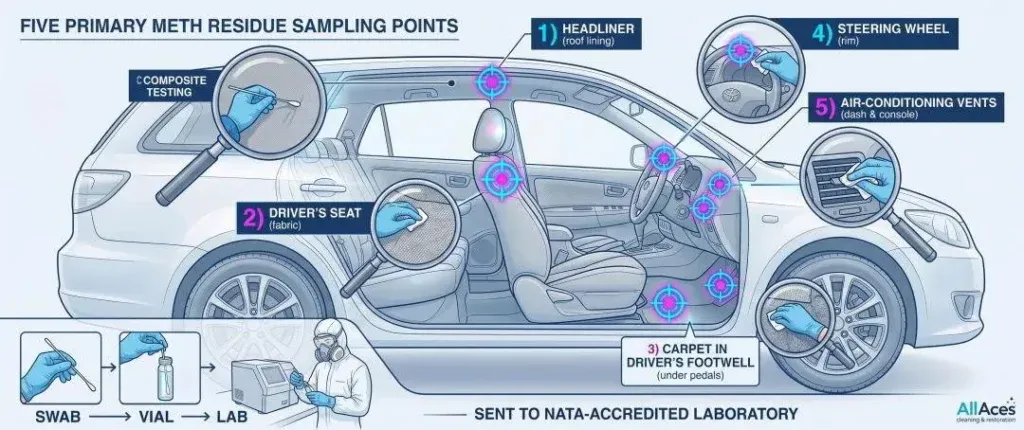
The same 2021 Flinders study found that 76% of surveyed Australian operators offer both testing and remediation. Its authors recommended that each stage of the decontamination process be offered as separate services by individual companies, and noted that a regulation process would help mitigate unethical practices.
Think about the incentive structure for a moment. The company that decides whether your property is contaminated is often the company that gets paid to fix it, and then the company that decides whether the fix worked.
Some state guidance already assumes the roles are separate. WA Health’s clandestine drug laboratory guidelines describe a forensic testing contractor developing and implementing the assessment, remediation and validation plan, with the remediation completed by a commercial cleaning contractor. Two parties, in the guideline’s own wording. Victoria’s practice note similarly has an assessor who confirms findings in writing, and after remediation provides written verification that residual contamination is below the investigation levels.
The correction that matters most in this whole article: under the Commonwealth model, site clearance is issued by the appropriate authority after it reviews the validation report and audit checklist. It is not issued by the contractor.
A document a remediation company hands you at the end of the job is a validation report. That is a legitimate and necessary thing. It is not a statutory clearance, and anyone presenting it as one is overstating it.
In Queensland, health risks from former illicit lab sites are regulated by local governments under the Public Health Act 2005. Queensland Health’s own advice is that post clean-up samples should be tested by an accredited laboratory that can certify the clean-up was successful. Where a Public Health Order has been issued, it is the local government that lifts it.
The numbers a certified job is measured against
0.5 µg / 100cm²
The methylamphetamine limit in the Commonwealth guidelines. Above it, the property is treated as contaminated.
22 µg / 100cm²
The separate action level for iodine, where iodine was used in manufacture. Clearance is not a single-analyte question.
Replicated sampling
Validation requires that testing done at the investigation stage is at minimum replicated across all remediated surfaces.
Chain of custody
Documented handling from swab to laboratory. Without it, a result is a number without provenance.
Scope of accreditation
The specific methods the laboratory is NATA accredited for. Check the report's method sits inside it.
Written verification
Victoria's practice note requires the assessor to confirm in writing that residual contamination is below the investigation levels.
If you want the underlying detail on thresholds, testing types and what remediation involves, that sits in our complete guide to meth decontamination in Australia and the step-by-step decontamination process.
Six questions that separate real operators from marketing
1. Which laboratory analyses the samples, and what is its NATA accreditation number?
You want a name and a number you can search. "We use a NATA lab" is not an answer.
2. Who does the clearance sampling, and are they independent of the remediation?
SA Health uses the word independent. WA Health separates the roles structurally. If the same crew cleans and clears, ask how that is managed.
3. Which guideline are you working to, by name?
The correct answer is the Commonwealth Clandestine Drug Laboratory Remediation Guidelines, plus the relevant state guidance. If they cannot name it, they are not working to it.
4. Who issued your certification, and for what scope?
There is no IICRC certification specific to methamphetamine or clandestine laboratory decontamination. Trauma and crime scene, applied microbial remediation and structural drying certifications are real and relevant. A vague "certified" is not.
5. Does the scope include ducting and ventilation?
Air conditioning and fans commonly carry the highest readings on site because they redistributed residue. A quote silent on HVAC is incomplete.
6. What is the waste chain, with documentation?
Material removed from a contaminated property is a licensed disposal stream, not a skip bin.
Our guide to choosing a meth removal service provider goes further on the commercial side of this.
Who pays, and what has to be disclosed

Rules vary by state, and the gaps are where people get hurt.
In Queensland, the Residential Tenancies Authority confirms that where a local government issues a Public Health Order, property owners are responsible for the costs of implementing its requirements. It also notes that Queensland Health’s Forensic and Scientific Services is an accredited laboratory providing sampling kits, which is a genuinely useful non-commercial option.
In New South Wales, there is a hard disclosure rule most people do not know about. Landlords and agents must tell a prospective tenant, before they enter the agreement, whether the property has been used to manufacture or cultivate a prohibited drug in the last two years. Note the wording: manufacture or cultivation, not use.
Insurance is unsettled. There is at least one AFCA determination, reported in 2020, in which an insurer was required to pay a landlord’s meth contamination claim on the basis that the proximate cause was a tenant’s use rather than a threatened contaminant, so a pollution exclusion did not apply. Outcomes turn on the exact policy wording and the facts, so treat that as evidence the question is arguable rather than settled.
Frequently asked questions
Is there a licence for meth decontamination in Australia?
No. Peer-reviewed Australian research published in 2021 found there is no legislation or regulation for meth remediation, no mandatory training and no standardised techniques. State building and trade licence registers in Queensland and New South Wales contain no class covering decontamination or hazardous materials remediation. What exists is a 2011 Commonwealth guideline, state health guidance, and a voluntary industry code of practice.
What does NATA accreditation actually certify?
It certifies the laboratory, for the specific test methods listed on its scope of accreditation under ISO/IEC 17025. It does not certify the person who took the swab, the sampling design, or the remediation work. NATA’s emblem rules also prohibit a report implying accreditation for services not on scope, so check which lines the endorsement applies to.
How do I check a testing laboratory is genuinely accredited?
Use NATA’s public search facility at nata.com.au/find-organisation. Search the laboratory named on your report by business name or accreditation number, then open its scope of accreditation and confirm the analytical method used on your report is listed there. If the report does not name the analysing laboratory, treat that as a red flag.
Should the company that cleans my property also do the clearance test?
Ideally no. SA Health’s guidance refers to a suitably qualified and independent expert, and WA Health’s guidelines describe the forensic testing contractor and the commercial cleaning contractor as separate roles. Australian research found 76% of operators offer both services and recommended they be separated. If one company does both, ask specifically how the clearance result is kept independent.
Is a clearance certificate from a remediation company legally binding?
Under the Commonwealth guidelines, site clearance is issued by the appropriate authority once it has reviewed the final validation report and audit checklist. A document issued by a remediation contractor is a validation report, which is necessary and useful, but it is not a statutory clearance. Where a Public Health Order applies, only the issuing local government can lift it.
Is there an IICRC certification for meth decontamination?
No. The IICRC’s published certification list includes Trauma and Crime Scene Technician, Applied Microbial Remediation Technician and Applied Structural Drying Technician among others, but no certification specific to methamphetamine, drug residue or clandestine laboratory decontamination. Providers advertising IICRC certified meth decontamination are applying adjacent credentials, which is not the same claim.
Does a landlord have to disclose meth contamination?
It depends on the state. In New South Wales, landlords and agents must disclose before a tenancy agreement is entered whether the property has been used to manufacture or cultivate a prohibited drug in the last two years. Queensland’s Residential Tenancies Act does not specifically require drug contamination disclosure, though lessors must still ensure premises are fit to live in.
The bottom line
“Certified” on its own is a marketing word in this industry, because there is no body issuing the certification it implies.
The things you can actually verify are narrower and better: a named laboratory with a NATA accreditation number you can look up, a scope of accreditation that covers the method on your report, an assessor with a real professional qualification, a guideline named out loud, and clearance sampling that is not marked by the same people who did the homework.
Ask those five questions. The gap between the companies that can answer them immediately and the ones that change the subject is the entire point of this article.
Need a property tested or decontaminated? AllAces provides methamphetamine testing and decontamination across Queensland, New South Wales and Victoria, working to the Commonwealth remediation guidelines with independent NATA-accredited laboratory analysis on every job.
Meth decontamination services | The complete Australian guide
Where to go next
This article covers credentials and verification. The rest of the cluster covers the work itself.
- Meth decontamination in Australia: the pillar guide, covering testing, thresholds, costs and clean up.
- Signs of a former meth lab: the ten forensic markers, and the far more common case with no markers at all.
- What decontamination costs: a real quote, worked through line by line.
- Case study: a 12 unit apartment block, and how contamination moved through shared ducting.
- Meth decontamination services: testing, remediation and independent clearance across QLD, NSW and VIC.
- Forensic and trauma cleaning: biological contamination is a separate discipline to chemical residue.
Sources: National Association of Testing Authorities; Commonwealth of Australia, Clandestine Drug Laboratory Remediation Guidelines (2011); Kuhn, Walker, Whiley, Wright & Ross, International Journal of Environmental Research and Public Health 18(17) (2021); Flinders University; Australian Institute of Occupational Hygienists; SA Health; WA Department of Health; Victorian Department of Health; Queensland Health; Residential Tenancies Authority Queensland; NSW Fair Trading; Queensland Building and Construction Commission; Environmental Health Australia; IICRC. Last reviewed September 2026.
Vetting a contractor, in order. Start here, then work through how to compare meth removal quotes for what a scope of works has to contain, and what DIY meth cleaning can and cannot fix if you are still weighing doing part of it yourself.
New to the problem rather than the paperwork? Meth contamination in Australian property is the overview, and it covers the signs, the 0.5 µg/100cm² threshold and where owners stand legally.
Ready to engage someone with accredited testing and clearance reporting: meth decontamination services. Call 1800 00 10 10.