A meth test comes back as a number, not a verdict. Somewhere on the report is a figure in micrograms per 100 square centimetres, and everything that happens next hangs off it: whether you remediate, what it costs, what you have to tell a tenant or a buyer.
Most people read that number the wrong way. They treat it like a pass or a fail. It is closer to a temperature reading, and like a temperature it only means something once you know where it was taken and how.
This guide is about interpreting the result. If you want the mechanics of how the sample gets taken in the first place, that is a separate job and we cover it in the meth testing process.
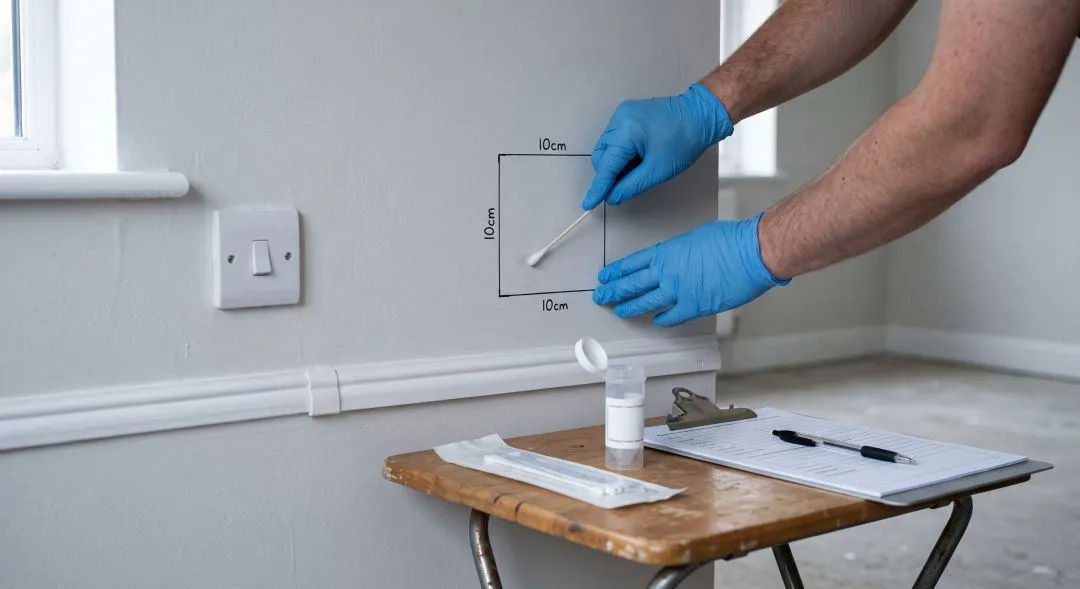
A wipe sample taken over a measured 100cm² template. The template is the reason the result is comparable to anything.
What the 0.5 microgram limit actually is
Australia’s remediation trigger for methylamphetamine is 0.5 micrograms per 100 square centimetres of surface. A property reading below that figure is generally considered fit for habitation. Above it, remediation is expected.
That number comes from the enHealth guidance on clandestine drug laboratories, which sits behind the Australian Voluntary Guidelines. Every state works off that national position. There is no separate NSW, Queensland or Victorian threshold that changes the maths.
Two things about it are worth understanding, because they are where most of the confusion starts.
It is an investigation level, not a poison line
0.5 is not the concentration at which residue becomes dangerous. It is the point at which the health authorities decided a property warrants action. A reading of 0.6 does not mean the house is toxic, and a reading of 0.4 does not mean it is pristine. It means one sits above the line that triggers a response and the other does not.
That distinction matters when you are negotiating with an insurer or a purchaser, because the conversation is about the trigger, not about harm.
It is a surface measurement, not an air measurement
Meth residue testing measures what has settled on and absorbed into surfaces. It says nothing directly about what is in the air right now. This is why a house can smell like nothing at all and still return a reading that puts it into remediation.
What each reading band tends to mean in practice
There is no official grading scale above the 0.5 trigger. What follows is how readings tend to play out on the jobs we scope, not a regulatory classification. Treat it as orientation, not as a rule.
| Reading | What it usually indicates | What it usually means for scope |
|---|---|---|
| Below 0.5 | Below the national investigation level. Either no use, or use light enough and long enough ago to have fallen away. | No remediation expected. Keep the report. |
| 0.5 to 2 | Light smoking residue, often confined to one or two rooms or a single high deposition surface. | Targeted clean, contents triage, usually days rather than weeks. |
| 2 to 10 | Sustained smoking. Residue has moved through soft furnishings and frequently through the air conditioning. | Multi room scope. Soft furnishings and some linings out. |
| 10 to 30 | Heavy, prolonged use, or a property used as a distribution point. | Substantial strip out. Framing washdown likely. |
| Above 30 | Frequently consistent with manufacturing rather than smoking, particularly alongside staining or chemical odour. | Treated as a clandestine laboratory until proven otherwise. Broader chemical panel needed. |
One caution on that table. A single high reading in a house full of low ones is a different problem to a house that reads moderately everywhere. The first is usually a contained event. The second means the residue has distributed, and distributed residue is the expensive kind.
Which is why the spread of your readings matters more than the peak.
Why the same house can produce two different numbers
Owners often get a second opinion and find the two reports disagree. That is usually not incompetence. It is method.
Where the sample was taken
Residue concentrates on high deposition surfaces: above door frames, on ceiling surfaces near where someone sat, inside wardrobes, on return air grilles. Sample those and you get a high number. Sample a skirting board and you may not.
Composite or discrete
A composite pools several surfaces into one result and returns an average. A discrete sample reports one surface on its own. The same house can read 1.2 composite and 6.0 discrete on its worst wall, and both are correct.
The template
The result is expressed per 100cm². If the area swabbed was not measured properly, the arithmetic behind the number is wrong before the lab sees it.
Kit versus laboratory
Presumptive field kits detect presence, not concentration. A kit result is not a number you can compare to 0.5 at all, whatever the packaging says.
Time and cleaning
Residue degrades slowly, but washing before testing moves it around and can suppress a reading without removing the contamination underneath.
The laboratory
Results should come from a NATA accredited laboratory with the method named on the report. Without accreditation, the number is an opinion.
So before you argue with a reading, check what kind of reading it is. Two numbers from two methods are not in conflict. They are answering different questions.
What the number does not tell you
A lab result can tell you
- Whether the surfaces sampled sit above or below 0.5 µg/100cm²
- How concentrated the residue is at those specific points
- With discrete sampling, which rooms are affected and which are clean
- Whether a remediation has worked, when repeated afterwards
- Something defensible to put in front of an insurer or a tribunal
It cannot tell you
- Whether anyone in the house has been harmed. That is a medical question, not a surface measurement
- When the contamination happened, or by whom
- Whether the property was used for smoking or manufacturing, unless a wider chemical panel was run
- What the remediation will cost. That comes from the scope the reading produces, not the reading itself
- Whether contamination exists in a room nobody sampled
That last one is the trap. A clean result only covers what was tested. If three rooms were sampled in a five bedroom house, you have information about three rooms.
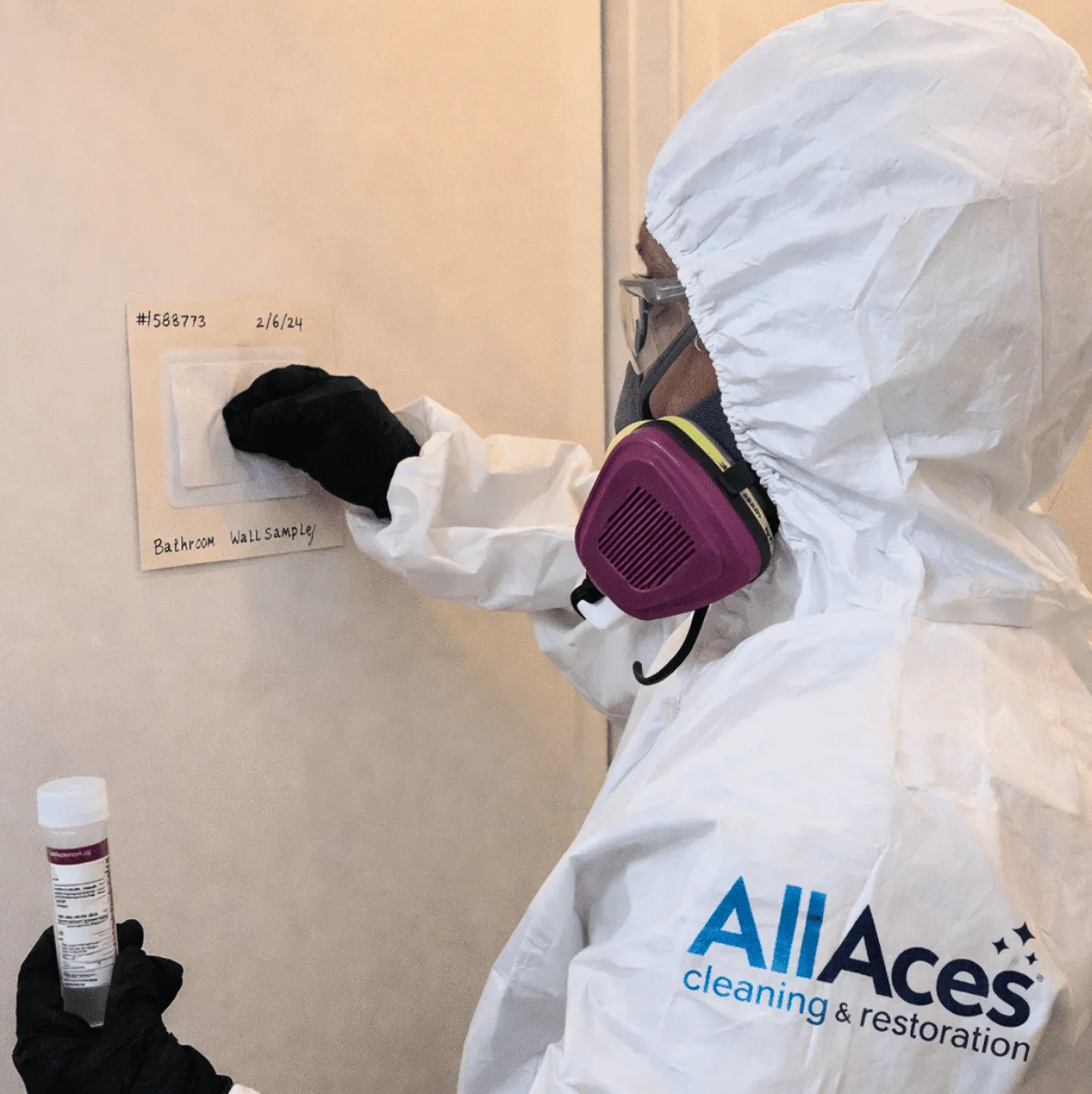
Sampling in protective equipment. The number on the report is only as good as the plan behind where it was taken.
Who actually decides whether a property is safe
This surprises people. The laboratory does not decide. It reports a concentration and stops there.
The assessor interprets it
Ideally a certified occupational hygienist. The Australian Institute of Occupational Hygienists holds the certification register. They turn a set of numbers into a site characterisation: which areas are affected, to what degree, and what has to happen.
The remediator scopes from that
A decontamination contractor prices what the report defines. Give them a vague report and you get a broad, expensive scope, because that is the only safe way to quote it.
Independent clearance testing closes it
After the work, a fresh round of sampling confirms readings have dropped below the threshold. It should be arranged independently of whoever did the cleaning. A clearance signed by the cleaner carries very little weight with an insurer or a purchaser’s solicitor.
Councils and insurers act on the paperwork
A local council can issue orders on the strength of a report. An insurer will assess a claim on it. Neither is interpreting the chemistry themselves. They are reading the documents.
The practical consequence: the quality of your assessment sets the quality of every decision after it. Cheap testing on a positive property is the most expensive saving in this industry, because the scope gets drawn wide to cover the uncertainty.
What to do with your result
| Your situation | Next step | Why |
|---|---|---|
| Kit says positive, no lab result | Order a laboratory screen before telling anyone | A kit cannot give you a concentration, and a false positive starts a disclosure conversation you cannot take back |
| Composite result above 0.5 | Pay for discrete, room by room sampling | It is the single biggest lever on the eventual remediation cost |
| Discrete result, some rooms clean | Get a written scope tied to that report | You now have grounds to keep clean areas out of the works |
| Reading just under 0.5 | File the report and keep it | It is your evidence at sale, at the end of a tenancy, and if a future test disagrees |
| Reading above 30, or staining present | Stop and treat it as a possible clan lab | Precursor chemicals need a broader panel than a methylamphetamine wipe |
| Post clean result still above 0.5 | Do not pay for a second clean from the same scope | A failed clearance usually means the scope was wrong, not that the cleaning was |
And whatever the number is, keep the documentation. In every dispute we have seen over a contaminated property, the person holding the accredited report with an intact chain of custody has been the person in the stronger position.
Frequently asked questions
Is 0.5 micrograms per 100cm² a safety limit or a legal limit?
Neither, strictly. It is a national investigation and remediation trigger drawn from enHealth guidance and adopted through the Australian Voluntary Guidelines. It is not written into legislation as a criminal or civil threshold, and it is not the concentration at which harm begins. It is the point at which authorities expect action to be taken.
My reading is 0.4. Do I have to disclose it?
A reading below the threshold does not usually trigger a remediation obligation. Disclosure is a separate question and depends on your state and the circumstances of the sale or tenancy. If you are selling in a jurisdiction where contamination can be a material fact, a below threshold report from an accredited laboratory is the document you want to be holding, not one you want to hide.
Can a reading get worse without anyone using in the property?
Not meaningfully. Residue does not multiply. What does change is where it is found, because disturbing surfaces, running air conditioning or cleaning can redistribute it. A higher second reading almost always means the first sampling plan missed the hot area.
Do I need to test every room?
Not always, but you need a sampling plan that justifies the rooms you skipped. A clean result only covers what was tested, and on a property with a known history a partial test is a partial answer.
How long do laboratory results take?
Three to five business days is standard in Australia. Express turnaround exists at a higher fee. Because most properties need testing twice, once as a baseline and once as clearance, allow around two weeks of calendar time even when the physical work is short.
Does a high reading mean the house has to be demolished?
Very rarely. Even heavy contamination is usually addressed by removing porous materials, washing structural surfaces and re-testing. Demolition becomes a conversation on some long running clandestine laboratories where precursor chemicals have soaked into framing, and even then it is the exception.
The short version
A meth reading is a measurement of a specific surface, taken a specific way. Before you react to it, find out where the sample came from, whether it was composite or discrete, and which laboratory ran it.
Above 0.5 means act. It does not mean panic, and it does not tell you how much of the property is involved. That answer comes from the sampling plan, and the sampling plan is the part you still have influence over.
Holding a result you are not sure how to read? AllAces has been doing decontamination work in Australia for more than 35 years across more than 65,000 jobs, with IICRC certified technicians and 24/7 response in Brisbane, Sydney, Melbourne and Ballarat. Call 1800 00 10 10, or get in touch here.
Reading bands above reflect patterns observed across AllAces jobs and are offered as orientation, not as a regulatory classification. The 0.5 µg/100cm² figure is the national remediation trigger drawn from enHealth guidance. Last updated September 2026.
This is one part of our guide to how meth decontamination works in Australia, which covers the warning signs, where the 0.5 µg/100cm² health investigation level comes from, real costs, and what landlords and sellers have to disclose.
The sampling sequence behind these numbers is set out in the meth testing process, and what happens after a failed result is the meth decontamination process. If the reading is high, what decontamination actually costs is the next thing worth reading.
Get a proper reading first through meth testing and decontamination. Call 1800 00 10 10.

