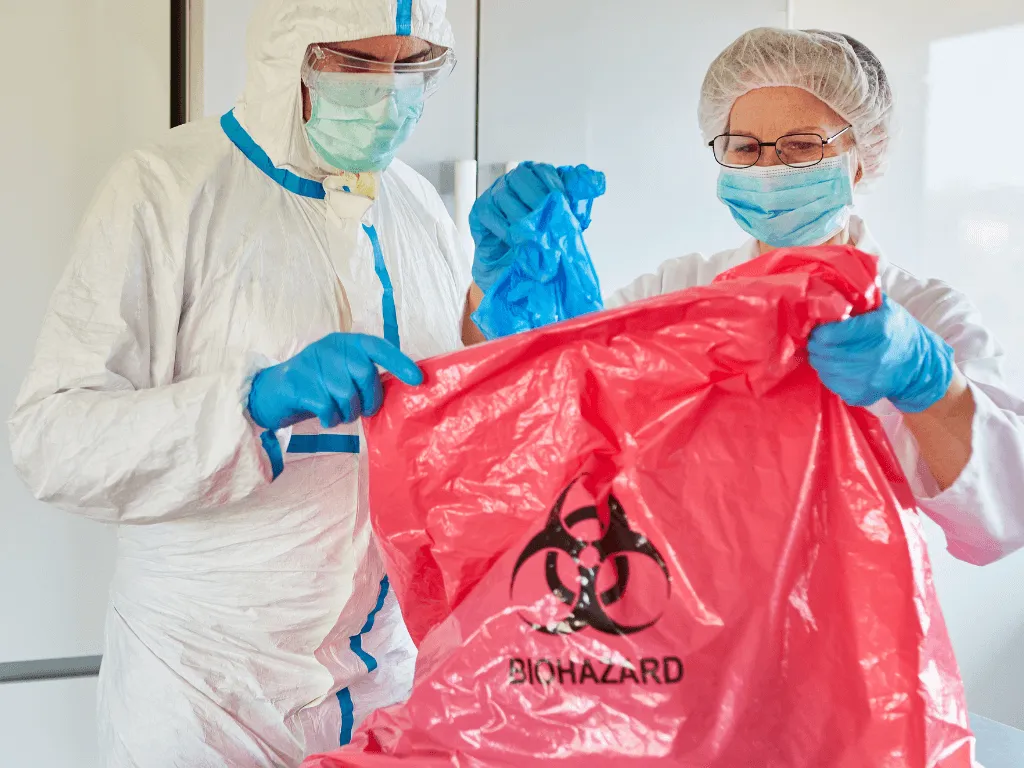
Forensic cleaning equipment falls into five groups: personal protective equipment, containment and air filtration, extraction and cleaning tools, regulated disinfectants, and verification and waste-handling gear. The disinfectant is the part Australian law actually regulates, and it is the part worth asking about first.
An equipment list is the easiest page in this industry to write and the least useful to read. Everybody has one. HEPA vacuum, ozone machine, UV torch, hospital-grade disinfectant, tick, tick, tick, call us today.
Here is the problem with that page. In Australia, almost none of the equipment is regulated. The disinfectant is. The waste is. The employer’s duty of care is. The machines are just machines, and a company can own an impressive-looking one and use it in a way that achieves nothing.
So this is a different kind of list. What each item is for, what it genuinely does, and where it stops. Including three things you will find on plenty of equipment pages, and until recently on this one, that do not stand up.
If you are evaluating a provider rather than satisfying curiosity, skip to the questions near the end. That is the useful part.
Key Takeaways
- Hospital grade disinfectant is a legally defined term in Australia, regulated by the TGA. Products making specific claims must be included in the Australian Register of Therapeutic Goods. Ask for the ARTG number.
- If a supplier still says TGO 54 compliant, their information is out of date. TGO 54 sunset on 1 April 2019 and was replaced by TGO 104.
- Ozone is controlled by a peak limit in Australia, not an average. 0.1 ppm, which cannot be averaged out. The US EPA notes no federal agency has approved ozone generators for occupied spaces.
- As used by NASA does not hold up. We used to say it. The underlying chemistry came from 1990s research on removing ethylene from spacecraft plant chambers, and NASA does not endorse commercial products.
- UV and forensic light sources are screening tools, not proof. Untreated blood absorbs light rather than fluorescing. Our previous version of this page overstated this and we have fixed it.
- HEPA means 99.97% at 0.3 microns, the hardest particle size to catch, not 99.97% of everything.
- Forensic cleaning is not a licensed trade in Australia. What is regulated is the waste, the disinfectant and the WHS duty. Which puts the checking on you.
1. Personal Protective Equipment
PPE for forensic work means a fit-tested respirator, fluid-resistant coveralls, nitrile gloves, eye protection and dedicated footwear. The item that decides whether the rest works is the respirator seal, and a respirator that has not been fit tested to the individual wearing it is close to decorative.
Two Australian specifics most equipment lists miss.
Fit testing is mandatory, and the wearer has to be clean shaven. WorkSafe WA’s guidance states that fit testing is a mandatory requirement of AS/NZS 1715, must be done before a respirator is first used and again when a new model is issued or the wearer’s face changes, and that wearers must be clean shaven or have facial hair that does not interfere with the sealing surfaces. That is a concrete, checkable thing. A technician with a beard in a tight-fitting respirator is not protected, whatever the box says.
The standards have not been superseded, despite what you may read. Standards Australia has adopted a suite of 30 ISO-based respiratory protection standards that will replace AS/NZS 1715:2009 and AS/NZS 1716:2012, but both sets run in parallel until 2030. So a P2 certified to AS/NZS 1716 is still entirely legitimate today. Check the marking rather than the marketing.
PPE gets one section here because it deserves a page of its own, and it has one: trauma cleaners’ personal protective equipment explained.
2. Containment and Air Filtration
Containment is physical barriers plus negative air pressure, so that air flows from clean areas into the work zone and never the other way. Air scrubbers with HEPA filtration then remove particulate from the air inside that zone. Without containment, cleaning one room contaminates the rest of the building.
On what HEPA actually means. The US EPA, citing the US Department of Energy definition, states a HEPA filter removes at least 99.97% of particles at 0.3 microns, and adds the detail almost everyone drops: 0.3 microns is the most penetrating particle size, the worst case, and particles both larger and smaller are trapped with even higher efficiency.
So “99.97% at 0.3 microns” is a stronger claim than the sloppy “99.97% of all particles”, not a weaker one. It is worth knowing because the industry version is technically wrong in a way that makes the product sound less good than it is.
On negative pressure. The principle comes from healthcare facility design. CDC guidance describes isolation rooms held under negative pressure so that airflow moves from the adjacent corridor into the room, and notes that portable industrial-grade HEPA units can provide the equivalent of additional air changes per hour. It also supports dust-control procedures and barriers during construction, repair, renovation or demolition, which is functionally what a decontamination strip-out is.
Those CDC air-change figures are hospital design specifications, not requirements for a residential job, and no Australian rule sets an air-change target for forensic cleaning. Anyone quoting you a mandatory number is inventing it. The principle is still the right one.
3. Extraction, Vacuums and Cleaning Tools
The unglamorous half of the kit, and the half that does most of the work.
HEPA vacuums for particulate, used before any liquid is introduced. Hot water extraction units for carpet, upholstery and porous soft furnishings, which pull contaminated liquid out of a material rather than pushing product into it. Steam for hard surfaces where heat helps and chemical residue is unwanted. Hand tools, scrapers, sharps tongs, and a lot of single-use disposable cloths, because a reused cloth transfers contamination between surfaces.
Sharps containers to compliant standards, because in hoarding, squalor and trauma environments needles turn up in places nobody predicted.
And demolition tools, which people do not expect on a cleaning list. Porous material that has absorbed blood or body fluids frequently cannot be decontaminated and has to be removed: carpet and underlay, plasterboard, subfloor timber, particleboard. Cutting out a section of floor is a legitimate and often necessary part of the job. A provider who never removes anything is not being gentle with your house, they are leaving contaminated material in it.
4. Disinfectants, and the Part Australian Law Actually Regulates
In Australia, hospital grade disinfectant is not a marketing phrase. It is a term defined in the Therapeutic Goods Regulations 1990, and disinfectants are regulated by the Therapeutic Goods Administration as therapeutic goods. Products making specific claims must be included in the Australian Register of Therapeutic Goods before they can be supplied.
This is the most important section on the page and it is the one nobody writes, so here it is properly.
The TGA regulates these products, not the cleaning industry. The TGA’s page on disinfectants and sterilants states that other therapeutic goods making specific claims “must be included in the Australian Register of Therapeutic Goods (ARTG) before supply.” Whether a given product needs ARTG inclusion depends on the claims it makes, and there are different pathways, so the clean practical version is this: ask your provider for the ARTG number of the disinfectant they use. That is checkable in about a minute and it is the single best test of whether someone knows what they are doing.
What a hospital grade claim actually requires. This is the concrete answer to “what is the difference between that and a supermarket spray”. Per the TGA’s own instructions for disinfectant testing, current at version 4.0, August 2025:
- A hospital grade disinfectant must pass Option B of the TGA Disinfectant Test under dirty conditions, and must also pass a bactericidal carrier test, achieving a minimum 5-log reduction.
- A household or commercial grade disinfectant may instead pass Option C of the TGA Test, or a test to EN 1276, or an appropriate bactericidal carrier test.
- Sporicidal and tuberculocidal claims require a 6-log reduction.
“Dirty conditions” is the TGA’s own term for testing in the presence of an organic soil load. Which is exactly why it matters here. A product tested on a clean laboratory surface tells you nothing useful about a surface with blood and tissue on it, and blood and tissue is the entire working environment of forensic cleaning.
One correction worth making publicly. A lot of Australian cleaning and supplier websites still describe their products as "TGO 54 compliant". TGO 54 sunset on 1 April 2019 and was replaced by Therapeutic Goods Order 104, the Standard for Disinfectants and Sanitary Products. The TGA's own page confirms TGO 104 replaced the previous TGO 54. If a supplier or a contractor is still citing 54, their compliance information is more than seven years out of date, and that tells you something about the rest of it.
Clean and decontaminated are not the same word
Worth pinning down, because the two get used interchangeably and they mean genuinely different things.
CDC definitions: cleaning is the removal of adherent visible soil, blood, protein substances, microorganisms and other debris, usually with detergent and water. Decontamination is the use of physical or chemical means to remove, inactivate or destroy bloodborne pathogens on a surface to the point where they are no longer capable of transmitting infectious particles. Sterilisation is a validated process rendering something free of all viable microorganisms, and it is not what happens to a bedroom floor.
The order is not negotiable either. WHO guidance notes surfaces must be cleaned with water and soap or a detergent first to remove dirt, followed by disinfection. Disinfectant applied to a soiled surface is largely wasted, because the organic load consumes it before it reaches anything.
Which is the whole reason “hospital grade under dirty conditions” is the right specification, and the reason a surface that looks clean is not evidence of anything.
5. Odour and Air Treatment: Ozone, Hydroxyl and Fogging
This is where equipment pages get least honest, including ours.
| Equipment | What it does | The regulatory position | Where it belongs |
|---|---|---|---|
| Ozone generator | Oxidises odour compounds. Aggressive and effective on some, ineffective on others | US EPA: no US federal agency has approved these for use in occupied spaces. Australia sets a peak limitation of 0.1 ppm | Sealed, unoccupied, monitored spaces with a documented clearance period. Never a home people are living in |
| Hydroxyl generator | Photocatalytic oxidation. UV light on a titanium dioxide catalyst generates hydroxyl radicals | No regulator has approved occupied-space use. US EPA reports PCO devices can generate formaldehyde and other byproducts | A legitimate tool, but safe in occupied spaces is a manufacturer claim, not an approved status |
| Thermal or ULV fogging | Distributes product as a fine mist over a wide area | US EPA does not recommend fogging unless the product label authorises it. WHO does not recommend routine indoor disinfectant spraying | A finishing step after cleaning, where the label allows it. Never instead of cleaning |
| HEPA air scrubber | Physically removes particulate from air | Well established. No byproducts | Running throughout, inside containment |
| Activated carbon and chemisorbent filtration | Adsorbs gaseous compounds | US EPA notes adsorbent and chemisorbent media are the gas-phase cleaners shown effective without producing harmful byproducts | Under-used, and the least controversial option on this list |
On ozone, in detail. The US EPA is unambiguous in its assessment of ozone generators sold as air cleaners: “NO agency of the federal government has approved these devices for use in occupied spaces,” and at concentrations that do not exceed public health standards, ozone “does not effectively remove viruses, bacteria, mold, or other biological pollutants” and “is not effective at removing many odor-causing chemicals.”
Australia’s own figure is stricter than people assume. Safe Work Australia lists ozone with a peak limitation of 0.1 ppm, or 0.2 mg per cubic metre. Not an eight-hour time-weighted average, a peak limit, meaning it must not be exceeded at any moment. There is no averaging it out over a shift.
And there is an actual Australian incident. WorkSafe Victoria issued a safety alert on ozone exposure in February 2025 after two workers at an aged care laundry were overcome by ozone gas from a malfunctioning generator, suffering sore throat and light-headedness. That was a laundry system rather than odour remediation, so do not read it as a finding about our industry. It is still a regulator warning about the machine.
Our previous version of this page listed ozone machines as “invaluable” with no caveat at all. That was wrong and it is now corrected. Ozone can be legitimate in a sealed, unoccupied, monitored space with a documented re-entry period. It is not something to leave running in an occupied house, and a provider who suggests otherwise should worry you.
On the NASA claim. Our previous version said our hydroxyl generator was “as used by NASA”. We have removed it, and it is worth explaining why rather than quietly deleting it.
Photocatalytic oxidation, the chemistry hydroxyl generators run on, was developed in the 1990s at a NASA research partnership centre at the University of Wisconsin-Madison, with support from Marshall Space Flight Center. NASA’s own account confirms the mechanism: when ultraviolet light strikes titanium dioxide, it frees electrons that turn oxygen and moisture into highly reactive hydroxyl radicals. But the purpose was removing ethylene gas from spacecraft plant-growth chambers, not biohazard remediation. It was commercialised by a private company, not NASA. And NASA does not endorse commercial products.
So the accurate sentence is: the underlying chemistry originated in NASA-supported research into ethylene scrubbing for plant growth in space. “As used by NASA” is not supportable, and we should not have written it. How we actually use these units is covered in why we use hydroxyl generators.
The honest distinction between hydroxyl and ozone is mechanistic. Hydroxyl radicals are extremely short-lived and are not subject to a workplace exposure limit the way ozone is, which is a real difference. But different from ozone is not the same as verified safe, and the US EPA’s technical summary on residential air cleaners reports that PCO air cleaners are often ineffective in completely transforming gaseous pollutants and have been shown to generate formaldehyde, acetaldehyde, nitrogen dioxide and carbon monoxide. Some units marketed as hydroxyl generators also produce ozone. Ask.
On fogging. The US EPA does not recommend fogging, fumigation, wide-area or electrostatic spraying unless the product label specifically includes directions for that method, because it has not evaluated safety and efficacy for methods the label does not address.
The label is the boundary. That principle lands harder in Australia than in the US, because here the label content for disinfectants is itself regulated under TGO 104. Using a product by a method its label does not authorise puts you outside the tested and approved use of a regulated therapeutic good.
Mechanically: fogging distributes product but removes no soil and delivers no mechanical contact. After cleaning, where the label allows, it is defensible. Instead of cleaning, it is theatre.
6. Detection and Verification
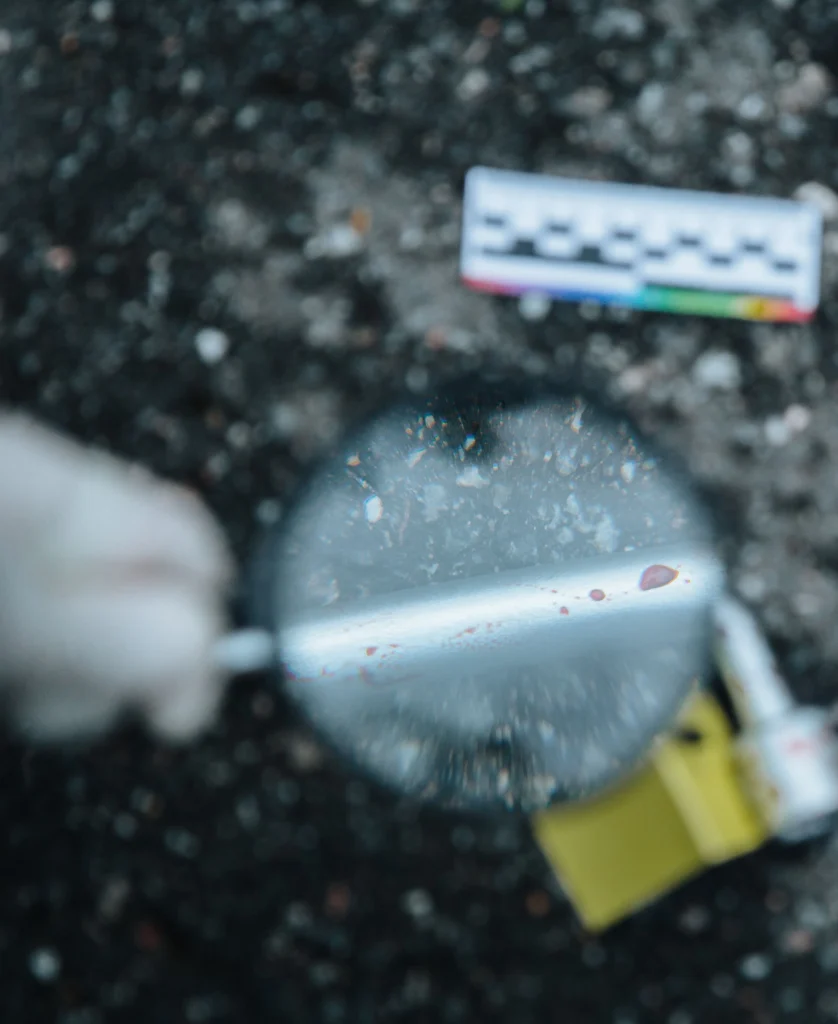
Forensic light sources and ATP testing both have real uses and both get oversold. Alternate light sources are presumptive screening tools that show where to look. ATP testing measures residual organic matter, which is not the same as measuring microbes. Neither is a certificate of decontamination.
Alternate light sources and UV. A 2018 report for the US National Institute of Justice confirms that semen, saliva and urine fluoresce under blue light in the 450 to 490 nanometre range, but lists untreated blood as detectable by absorption only, meaning it absorbs rather than fluoresces. The report describes alternate light sources as a screening tool used to identify evidence that is then tested in a laboratory.
Our previous version said UV lights are used “to ensure that no trace of contamination remains.” That is not what these tools do and we have corrected it. They indicate where residue is likely to be, on some fluid types, which is genuinely useful for finding spread you would otherwise miss under a bed or behind a skirting. Detection is not identification, and absence of fluorescence is not proof of cleanliness.
ATP bioluminescence testing. This one is more interesting than the marketing suggests, in both directions.
Peer-reviewed research in BMC Infectious Diseases found no statistical correlation between ATP readings and microbiological counts on the same surfaces, and concluded that ATP results cannot be interpreted as an indicator of microbial contamination, because ATP indicates organic material rather than microbes. So ATP testing does not prove a surface is pathogen-free, and anyone implying it does is wrong.
But read the rest of that study. The same authors found it “a useful tool to measure the efficiency of cleaning procedures”, including in environments with very low microbial counts. And organic material is exactly what forensic cleaning is removing. Blood, tissue, protein. Measuring whether the organic soil is gone is the right question for this work.
One more detail from the paper worth using as a test question: the authors note each facility should establish its own reference values depending on the device used. So if a provider quotes you a universal pass number, ask where that number came from.
7. Waste Handling, Which Is the Genuinely Regulated Part
Clinical and related waste is a dangerous good, and moving it requires a regulatory permission rather than just a van. In Victoria, clinical waste is a reportable priority waste requiring an EPA permission, tracked electronically every time it changes hands. This is the most verifiable compliance test available to a customer.
Transport requires a permit and a tracked chain of custody. EPA Victoria classifies clinical and related waste as reportable priority waste under code R100, requiring an A10a permission to transport, and requires transporters to track the waste through Waste Tracker and notify every time it changes hands. NSW operates a parallel regime, where waste transporters are responsible for tracking hazardous waste in accordance with the POEO (Waste) Regulation.
The packaging is prescribed. SafeWork NSW guidance requires clinical waste containers to be of rigid construction with a lid securable during transport, easily identifiable by colour, and marked with the Division 6.2 label, the UN3291 marking and an approved shipping name such as “CLINICAL WASTE, UNSPECIFIED, N.O.S.”, under the Australian Dangerous Goods Code. Sharps containers carry additional requirements.
There is an Australian Standard for the waste, even where there isn’t one for the cleaning. AS 3816:2018 Management of Clinical and Related Wastes covers identification, segregation, handling, storage, transport, treatment and disposal. Worth knowing it is a voluntary standard unless called up by legislation, and it is called up differently in different states.
So the checkable question is: who transports the waste, under what EPA permission, and can I see the consignment documentation? A legitimate operator answers that immediately.
Our procedures on this are set out in forensic cleaning and biohazard waste disposal.
Who Actually Regulates This Work
There is no single Australian licence for forensic cleaning as a trade, and the leading standard for the work itself is a voluntary American one with no legal force here. What is regulated is the conduct around it: the disinfectant by the TGA, the waste by state EPAs, and the employer's obligations under work health and safety law. Which means the burden of checking a provider falls largely on you.
That is an uncomfortable thing for a cleaning company to publish and it is the truth.
The WHS duty is real and it is brand new. Safe Work Australia published a model Code of Practice: Managing the risks of biological hazards at work in March 2026. It covers exposure to human biological materials including blood, faeces, urine, saliva, mucus, semen, carcasses and birth products, requires that risks be eliminated where reasonably practicable and otherwise minimised, and sets out the hierarchy of control: eliminate, then substitute or isolate or engineer, then administrative controls, then PPE. Note that it is a model code, which takes legal effect as each jurisdiction adopts it, and adoption varies.
The work standard is voluntary and American. ANSI/IICRC S540 Standard for Trauma and Crime Scene Cleanup, second edition 2023, describes the procedures and precautions for trauma and crime scene cleanup regardless of surface, item or location. It is a recognised international benchmark and working to it is a meaningful quality signal. It is not an Australian Standard and it carries no legal force here. Be wary of anyone claiming to meet “the Australian Standard for forensic cleaning”, because there isn’t one.
Certification is voluntary too. The American Bio Recovery Association’s Certified Bio Recovery Technician credential requires training hours, a proctored 100-point exam passed at 75 or better, current bloodborne pathogen training and annual recertification, and describes itself as entry-level third-party certification. That is a real credential. It is still certification, not licensing.
Training pathways in Australia are covered in what training do forensic cleaners go through.
Nine Questions Worth Asking Before You Hire Anyone
- What is the ARTG number of the disinfectant you will use on this job?
- Is it hospital grade, and was it tested under dirty conditions?
- Who transports the clinical waste, and under what EPA permission? Can I see the consignment documentation afterwards?
- Have your technicians been fit tested for their respirators, and when?
- Will you be using ozone, and if so, how long before the space is safe to re-enter?
- Does your hydroxyl unit produce ozone as a byproduct?
- What porous materials do you expect to remove rather than clean, and why?
- If you verify the clean, what method, and where did your pass threshold come from?
- What standard does your process follow?
Every one of those is answerable in a sentence by an operator who knows their business, and every one is checkable. If the answer to any of them is a brochure, that is your answer.
Frequently Asked Questions
What equipment do forensic cleaners use?
Five categories: personal protective equipment including fit-tested respirators and fluid-resistant coveralls; containment barriers and HEPA air scrubbers running under negative pressure; HEPA vacuums, hot water extraction units, steam and disposable hand tools; TGA-regulated hospital grade disinfectants; and verification and waste-handling equipment including compliant clinical waste containers. Demolition tools also feature, because porous material that has absorbed body fluids often cannot be decontaminated and has to be removed.
What makes a disinfectant hospital grade in Australia?
It is a legally defined term, not a marketing one. Disinfectants are regulated by the Therapeutic Goods Administration, and hospital grade is defined in the Therapeutic Goods Regulations 1990. To support a hospital grade claim, TGA guidance requires the product to pass Option B of the TGA Disinfectant Test under dirty conditions, meaning in the presence of organic soil, plus a bactericidal carrier test achieving at least a 5-log reduction. Household and commercial grade products face lower requirements. Ask for the ARTG number.
Are ozone machines safe for removing odours after a biohazard clean-up?
Not in an occupied space. The US EPA states no US federal agency has approved ozone generators for use in occupied spaces, and that at concentrations within public health standards ozone does not effectively remove biological pollutants or many odour-causing chemicals. In Australia ozone carries a peak exposure limit of 0.1 ppm, which cannot be averaged out over a shift, and WorkSafe Victoria issued a safety alert in 2025 after two workers were overcome by ozone from a malfunctioning generator. Ozone can be legitimate in a sealed, unoccupied, monitored space with a documented clearance period before re-entry.
Can UV light prove a surface is free of contamination?
No. Forensic alternate light sources are presumptive screening tools. Research for the US National Institute of Justice confirms that fluids such as semen, saliva and urine fluoresce under blue light, but that untreated blood absorbs light rather than fluorescing, and describes these tools as screening methods where laboratory testing follows. They are useful for finding spread you would otherwise miss. An absence of fluorescence is not evidence a surface is decontaminated.
Is forensic cleaning regulated or licensed in Australia?
Not as a trade. There is no single Australian licence for forensic cleaning, and the leading standard for the work itself, ANSI/IICRC S540, is a voluntary American National Standard with no legal force in Australia. What is regulated is the conduct around the work: the disinfectant by the TGA, clinical waste transport by state EPAs under permit and tracking requirements, and the employer’s duties under work health and safety law, now addressed by a Safe Work Australia model Code of Practice on biological hazards published in March 2026. In practice that means verifying a provider is your responsibility.
Why Choose AllAces
35+ years, three states
Trauma, forensic and biohazard work across Brisbane, Sydney and Melbourne as a specialty, not a sideline.
IICRC-certified technicians
Working to recognised standards, and able to tell you which ones.
Documented waste chain
Permitted transport and consignment records you can ask to see.
We will tell you what the equipment cannot do
As this page does.
Our forensic cleaning and biohazard decontamination teams handle the work this equipment is for, alongside trauma cleaning, crime scene cleaning and deceased estate cleaning and clear out.
For how the job actually runs, see our step by step guide to forensic cleaning procedures. For what it costs and why, see the costs involved in forensic clean up.
Trust the experts and contact the team on 1800 00 10 10.
This is one part of our guide to what forensic cleaning involves in Australia, including the licensing position, the clinical waste rules and who pays for the work.
Equipment only matters in the hands of someone trained to use it, which is covered in forensic cleaner training and certifications. To see where each item is used in sequence, read forensic cleaning procedures.
Biohazard decontamination and forensic cleaning by IICRC-certified technicians. Call 1800 00 10 10.
