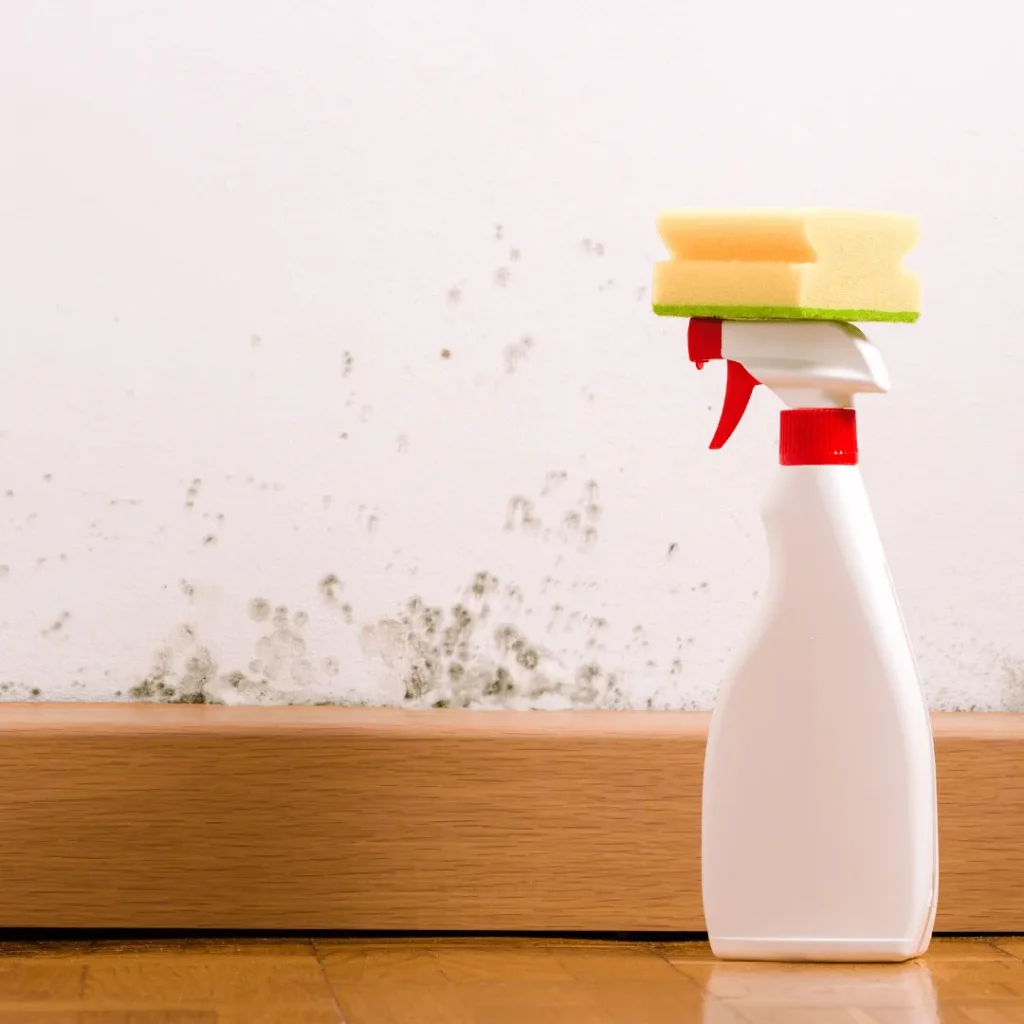
Almost every guide to mould on porous surfaces starts with a recipe. Borax. Hydrogen peroxide. A vinegar and bicarb paste. Scrub, rinse, done.
Australian health and workplace regulators start somewhere else entirely, and it is worth knowing before you spend a Saturday on it. Their guidance is not mainly about what to clean with. It is about deciding which materials are worth cleaning at all.
SafeWork NSW, in guidance updated December 2025, recommends discarding porous materials including ceiling tiles, plasterboard, insulation and carpets where they cannot be readily cleaned, have been wet for more than 48 hours, or have visible mould growth.
That single sentence reorganises this whole topic. So this guide is built around the decision, not the recipe.
Key takeaways
- Porous does not mean absorbent, it means hollow. The US EPA describes mould growing on or filling in the empty spaces and crevices of porous materials, which is why it may be difficult or impossible to remove completely.
- 48 hours is the deciding number. SafeWork NSW and WorkSafe Queensland both use it: porous material wet longer than that, or showing visible growth, gets discarded rather than cleaned.
- Bleach is the wrong tool here. Queensland Health states directly that bleach may not be effective in killing mould on porous surfaces.
- Vinegar at four to one, not fifty-fifty. NSW Health recommends four parts white vinegar to one part water. The 50/50 mix repeated across the internet is weaker than the health advice.
- About a square metre is the DIY ceiling. WA Health uses 1 square metre. The US EPA uses 10 square feet, which is just under a square metre. Two independent authorities landing on the same number is unusual and useful.
- Never dry-brush or vacuum it with a household vacuum. Both send spores airborne. WorkSafe Queensland specifies an H-class industrial vacuum instead.
- If it comes back, the material was never the problem. Moisture was.
Can you actually clean mould out of a porous surface?
Sometimes, and not reliably. Mould grows into the internal void structure of porous materials, so surface cleaning removes what you can see and leaves what you cannot. Dense materials such as sealed timber, concrete and grout can usually be cleaned. Soft or paper-faced materials such as plasterboard, carpet backing, insulation and ceiling tiles are generally replaced, not cleaned.
Western Australia’s Department of Health says the same thing in plainer language, and it names the materials: mould may be difficult to completely remove from absorbent or porous material such as carpet, tiles, gyprock and raw wood, because the mould can grow into the empty spaces and crevices of the material. It adds that these items are often not economically salvageable and must be thrown out.
That is a health department telling you plasterboard usually goes in the skip. Most cleaning guides will not tell you that, because there is no product to sell at the end of it.
What "porous" actually means, and why it changes everything

People picture porous material as a sponge that soaks things up. The more useful picture is a honeycomb.
Plasterboard, carpet backing, ceiling insulation, unsealed timber, grout and concrete all contain a network of tiny voids. Mould does not sit on that surface. It grows into it, occupying spaces a cloth was never going to reach.
Which is why the visible result of cleaning can be excellent and the actual result can be temporary. You removed the growth on the outside of the honeycomb. The material still holds viable growth and, just as importantly, still holds the moisture that fed it.
One nuance worth having, because it is the difference between a repair and a rebuild. The US Institute of Medicine’s review of damp indoor spaces notes that most guidance agrees solid lumber can generally be cleaned and saved, while paper-faced gypsum board, cellulose ceiling tile, paper and textiles are recommended for removal. Timber framing is often salvageable. The plasterboard nailed to it usually is not.
The 48-hour rule that decides most of it
Three Australian regulators independently use the same threshold, which is about as close to consensus as this field gets.
SafeWork NSW and WorkSafe Queensland both recommend discarding porous materials that cannot easily be cleaned, have been wet for more than 48 hours, or have visible mould. Queensland Health phrases it as more than two days, and names mattresses, carpet, leather goods and ceiling insulation.
The US EPA states the same idea from the preventive direction: if wet or damp materials are dried 24 to 48 hours after a leak or spill, in most cases mould will not grow.
So the honest sequence is: dry it fast and you have a cleaning job. Miss the window on a porous material and you have a removal job. That is not a sales pitch, it is four regulators saying the same thing.
Common belief: if you kill the mould, the material is fine.
Reality: killing it and removing it are different jobs, and on porous material the second one often cannot be completed.
Why it matters: dead spores still trigger allergic responses, and material that stayed wet long enough to grow mould has usually lost integrity as well.
Material by material: clean it, treat it, or take it out
Based on the US EPA’s material guidance and Australian health department advice. The column that matters is the third one.
| Material | Porosity | Realistic outcome | Method |
|---|---|---|---|
| Sealed tile, glass, metal, laminate | Non-porous | Fully cleanable | Damp wipe with detergent or vinegar solution, dry completely |
| Grout and unsealed stone | Porous but dense | Usually cleanable | Vinegar solution, dwell time, agitate, dry, then re-seal |
| Concrete and cinder block | Porous, dense | Cleanable | Detergent scrub and HEPA vacuum after drying |
| Solid timber, structural framing | Porous | Usually salvageable | Clean, dry to a verified moisture content, sand or encapsulate |
| Plasterboard and paper-faced gypsum | Highly porous | Generally replace | Cut back beyond the affected area, dispose bagged |
| Ceiling tiles and insulation | Highly porous | Replace | Remove, bag, dispose. Rarely economic to treat |
| Carpet and underlay | Highly porous | Replace if wet over 48 hours | NSW Health notes absorbent material may need professional cleaning or replacement |
| Upholstery, curtains, mattresses | Highly porous | Case by case, mattresses usually out | Better Health Channel advises disposing of mouldy items that cannot be cleaned |
| Cardboard, books, paper | Highly porous | Discard | No practical treatment for a domestic setting |
What Australian health departments actually tell you to clean with

Notably, none of them mention borax or hydrogen peroxide. Both are all over the internet and neither appears in guidance from NSW Health, Queensland Health, SA Health, WA Health, Better Health Channel, the US EPA or the WHO. Treat that absence as information.
1. White vinegar solution, four parts to one
NSW Health recommends mild detergent, or vinegar diluted in water at four parts vinegar to one part water. Give it real dwell time before you wipe. The commonly repeated 50/50 mix is weaker than the health advice, which is one reason DIY jobs come back. Also worth noting: no Australian health department publishes a kill-rate percentage for vinegar. If a page quotes you one, they made it up.
2. Household detergent, which is genuinely enough for small jobs
Better Health Channel is relaxed about this: in many cases, household detergent or white vinegar will be sufficient. Mechanical removal does most of the work. The chemistry does less than people assume.
3. Bleach, with a real caveat on porous surfaces
NSW Health gives a dilution of 250ml of bleach in 4 litres of water. SA Health uses 1 part bleach to 3 parts water. State guidance genuinely varies, so follow your own state's. But the important line here is Queensland Health's: bleach may not be effective in killing mould on porous surfaces. The US EPA goes further and says using a biocide such as chlorine bleach is not recommended as a routine practice during mould cleanup. Bleach removes the colour, which on a porous surface can look exactly like success.
4. Clean wider than the visible growth
The Australian CDC advises cleaning about 50cm around the visible mould, because not all mould is visible. Cheap advice, rarely followed, and it matters most on porous surfaces where the edge of the growth is not the edge of the problem.
5. PPE, which is not optional once you start disturbing it
The Australian consensus is a P2 or N95 respirator, gloves and eye protection, with the area ventilated. Better Health Channel adds a shower cap, overalls and suitable footwear. SafeWork NSW specifies a properly fitted disposable P2 mask, gloves and safety glasses as the minimum.
Primary sources: NSW Health, Queensland Health, Better Health Channel and the US EPA brief guide.
The mistakes that spread mould instead of removing it
Never mix bleach with vinegar, ammonia or other cleaners. Better Health Channel and every health department that mentions it give the same warning: this can release hazardous chlorine or chloramine fumes. People do this accidentally all the time by using one product after another on the same surface.
Do this
- Fix the moisture source first, before any cleaning
- Wet the surface before you disturb it, so spores stay put
- Wipe and lift rather than scrub and scatter
- Bag porous waste on the spot, before carrying it through the house
- Dry the area completely afterwards, with air movement
- Clean about 50cm beyond what you can see
Not this
- Dry brushing, which SA Health warns disperses spores into the air
- Using a household vacuum. WorkSafe Queensland specifies an H-class industrial vacuum instead
- Compressed air or dry sweeping, for the same reason
- Painting over it. The growth continues under the film
- Sealing a damp surface, which traps the moisture that caused it
- Cleaning it again next month instead of finding the leak
The vacuum point deserves emphasis because it is the most common DIY error. A domestic vacuum’s filtration passes fine spores straight through the exhaust and distributes them across the house. The US EPA notes HEPA vacuuming belongs at the end of the job, after materials have been dried and contaminated materials removed, not as the first step.
How big is too big for DIY?
About one square metre. WA Health treats contamination up to 1m² as simple and anything larger, or spread across multiple rooms, as complex. The US EPA says that below about 10 square feet, roughly a 3ft by 3ft patch and just under a square metre, most people can handle the job themselves. WorkSafe Queensland bands it as small under 1m², medium 1 to 10m², large above 10m², and advises professional advice for medium and large.
Two things that override the measurement, though.
SafeWork NSW frames the decision as competence rather than size, and notes mould requires immediate attention regardless of severity. And NSW Health does not give an area figure at all, saying instead that if you think you have mould but cannot find the source of the problem, you could employ an occupational hygienist.
That is the more useful test in practice. Size tells you how much work it is. Not knowing where the water is coming from tells you whether you should be doing it.
What professional remediation adds that a spray bottle cannot

Containment
Sealed sheeting isolates the work area so removing porous material does not contaminate the rest of the building.
Negative pressure
Air is pulled out of the containment rather than pushed through the house. The EPA's field check: the sheeting should billow inward.
H-class and HEPA extraction
Filtration that actually holds spores, used as a final clean after drying and removal rather than as the first move.
Moisture diagnosis
Meters and thermal imaging find the water behind the wall. Without that, everything else is temporary.
Structural drying
Bringing materials back to a verified moisture content, not just to dry-to-touch.
An Australian Standard
Standards Australia has adopted AS-IICRC S520 Standard for Professional Mould Remediation, a modified adoption of ANSI/IICRC S520:2024. There is now a national benchmark to work to.
That last point is genuinely new and most operators have not caught up with it. Australia also now has AS-IICRC S500 for water damage restoration, published 1 April 2025. If you are engaging a contractor, asking which standard they work to is a fair and revealing question.
Our mould removal and remediation service covers assessment through to clearance. Where the growth followed a leak or flood, it usually sits alongside water damage restoration, because drying the structure is what stops it returning.
Frequently asked questions
Can mould be completely removed from plasterboard?
Usually not. Paper-faced gypsum board is highly porous and mould grows into its internal structure, so surface treatment leaves growth behind. SafeWork NSW recommends discarding porous materials including plasterboard where they have visible mould or have been wet for more than 48 hours. The standard approach is to cut back beyond the affected area and replace, then fix the moisture source.
Does bleach kill mould on porous surfaces?
Queensland Health advises that bleach may not be effective in killing mould on porous surfaces. The US EPA does not recommend chlorine bleach as a routine practice during mould cleanup, and WA Health notes bleach products do not appear very effective at preventing longer-term regrowth. Bleach removes the pigment, which can make a porous surface look clean while growth remains inside it.
What is the correct vinegar to water ratio for cleaning mould?
NSW Health recommends four parts white vinegar to one part water, not the fifty-fifty mix that circulates online. Apply it, allow real dwell time before wiping, and dry the surface completely afterwards. No Australian health department publishes an efficacy percentage for vinegar, so treat any quoted kill rate as marketing rather than evidence.
How much mould can I safely clean myself?
Roughly one square metre. WA Health treats up to 1m2 as simple contamination and anything larger, or across multiple rooms, as complex. The US EPA sets its threshold at about 10 square feet, just under a square metre. WorkSafe Queensland recommends professional advice for anything from 1m2 upward. If you cannot locate the moisture source, get advice regardless of size.
Can I vacuum mould off carpet or a couch?
Not with a household vacuum. WorkSafe Queensland specifically advises avoiding dry sweeping, household vacuums and compressed air, because all three send spores airborne. An H-class industrial vacuum with appropriate filtration is the correct tool, and HEPA vacuuming belongs at the end of the job after drying and material removal, not at the start.
Why does mould keep coming back after I clean it?
Because the moisture is still there. NSW Health states that mould is likely to return unless you also treat the cause of the problem, and Better Health Channel notes the way to control indoor mould is to control the source of moisture. Recurrence after cleaning is a diagnostic result, not a cleaning failure: it tells you there is an active water source you have not found yet.
Is a mouldy mattress worth cleaning?
Usually not. Queensland Health advises that porous items which cannot easily be cleaned and have been wet for more than two days should be thrown out, naming mattresses specifically, and Better Health Channel advises disposing of mouldy items that cannot be cleaned including mattresses. Foam is highly porous and growth reaches well below any surface you can treat.
The bottom line
Cleaning mould from a porous surface is a decision before it is a technique.
Work out what the material is. Work out how long it was wet. If it is dense and it was caught quickly, clean it with detergent or a four to one vinegar solution, dry it hard, and move on. If it is soft, paper-faced or was wet for more than two days, take it out. That is not defeatism, it is what four Australian regulators recommend.
Then, either way, find the water. Half of Australians reported mould or dampness in their home in the past twelve months, according to Asthma Australia. Most of those are not cleaning problems that keep failing. They are moisture problems that keep being cleaned.
Mould that keeps coming back? AllAces has run mould remediation across Brisbane, Sydney and Melbourne for more than 35 years as an IICRC Certified Firm, with moisture diagnosis and containment on every job.
Mould removal and remediation | How to choose a mould remediation company
Where to go next
This article covers the porous-material decision. The rest of the cluster goes surface by surface.
- How to remove mould: the complete guide, covering causes, colours and method.
- Mould in tile grout: the porous surface most people can actually save.
- Mould on fabric and upholstery: care codes, dwell times and what not to put in the wash.
- What mould removal costs: how scope and material replacement drive the number.
- Mould removal services: assessment, containment, removal and drying across QLD, NSW and VIC.
- Water damage restoration: deal with the water first if growth followed a leak or storm.
Sources: SafeWork NSW (December 2025); Workplace Health and Safety Queensland; Queensland Health (November 2025); NSW Health; SA Health; WA Department of Health, Guidelines for Managing Mould and Dampness Related Public Health Issues; Better Health Channel (Victoria); Australian Centre for Disease Control; US Environmental Protection Agency; Institute of Medicine, Damp Indoor Spaces and Health; WHO Guidelines for indoor air quality: dampness and mould; Asthma Australia; Standards Australia AS-IICRC S520 and AS-IICRC S500. Last reviewed September 2026.