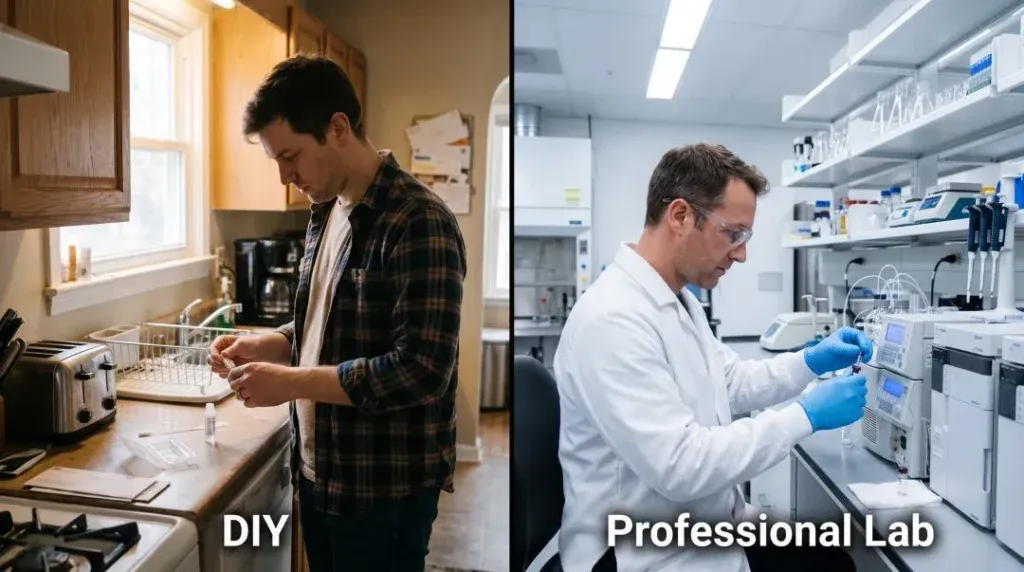
A house drug test checks surfaces inside a property for drug residue, almost always methamphetamine. You can do a rough version yourself with a kit from a hardware store or online, or have a technician take samples for a NATA accredited laboratory. The two give you very different answers, and only one of them holds up when money is on the line.
This guide covers what each test can tell you, when a DIY kit is enough, and when you need laboratory meth testing instead.
Can you drug test a house yourself? Yes, with a surface drug testing kit. A kit tells you whether methamphetamine is on the spot you wiped. It can’t tell you how much, can’t speak for the rest of the house, and won’t be accepted by an insurer, a tribunal or a buyer. For any of those, you need a laboratory result measured against 0.5 micrograms per 100cm².
Key takeaways
- Kits detect, labs measure. A DIY kit gives a yes or no. A laboratory gives a number, and the number is what the national guideline is written in.
- A negative kit clears one spot. It says nothing about the room next door, the ceiling or the ducting.
- A positive kit means stop, not clean. Book a laboratory test before anyone wipes, paints or pulls up carpet.
- Kits suit low-stakes checks. A quick look at a rental between tenants, or a gut check before you book a property inspection.
- Anything with a contract, a bond or a claim attached needs a laboratory. Buying, selling, end of tenancy disputes and insurance all turn on a measured result.
Two ways to drug test a house
How DIY meth test kits work
Most kits use a swab or wipe and a reagent that changes colour if methamphetamine is present above a set cut-off. You wipe a measured patch of wall, door frame or bench, run the test, and read a line or a colour.
That’s genuinely useful for one thing: finding out quickly whether something is there. It isn’t a measurement. A kit can’t tell 0.6 from 60, and the difference between those two numbers is the difference between a clean and a strip-out.
Kits also depend on where you wipe. Residue settles unevenly. The highest readings in a house are often on ceilings, near return air grilles and inside wardrobes, not at eye height on a hallway wall. A negative result on the wrong surface feels reassuring and proves very little.
Check the cut-off. Some kits test for more than one drug on the same swab. That doesn’t make them more accurate for meth. Read the cut-off on the packet: if it’s higher than 0.5 µg/100cm², a property can fail the guideline and still show negative on the kit.
When a DIY kit is enough, and when it isn’t
A kit is fine for
- A quick check of a rental between tenants, before you decide whether to book a full test
- A gut check on a property before you pay for a building inspection
- Peace of mind in a home you already own, with no sale, lease or claim in play
- Deciding which rooms to ask a technician to prioritise
You need a laboratory for
- Buying a property, as a condition of the contract
- Selling, where a clean result is something you’ll show the buyer
- An end of tenancy dispute or a bond claim
- An insurance claim
- Clearance after a meth clean-up
- Any result you might have to defend later
What a laboratory house drug test involves
A technician visits, asks about the property’s history and writes a sampling plan before taking a swab. Each sample is taken over a measured template, sealed, labelled and logged on a chain of custody form, then analysed by a NATA accredited laboratory. Results come back as a concentration for each sample, so you know which rooms are affected and by how much.
That sampling plan and chain of custody are what a kit can’t give you. They’re why a laboratory result stands up with an insurer or a tribunal and a kit result doesn’t. Each step is set out in how meth testing works.
Your kit came back positive. Now what?
Don’t clean, sand, paint or remove carpet. Disturbing residue spreads it and can make a later test harder to read.
Photograph the kit, and note the date, the room and the exact surface you wiped.
Ask for discrete sampling, so the result shows which rooms are affected rather than one combined figure.
Above 0.5 µg/100cm² means remediation is expected, and how far above changes what happens next. See what a meth testing reading means.
The laboratory report is what a scope of works, an insurer or a tribunal will rely on.
What each option costs
A DIY kit is cheap, and that’s its strength. A laboratory test costs more because it buys you a measured, defensible result. As a guide, laboratory testing runs from about $400 to $1,200 for a composite screen and $1,200 to $3,000 for discrete room-by-room sampling, depending on the size of the property. The full breakdown is in meth testing in Australia.
The useful way to think about it: a kit is worth buying when being wrong costs you little. When being wrong could cost you a property settlement, a bond or a remediation bill, the laboratory test is the cheap option.
Frequently asked questions
Can you drug test a house yourself?
Yes. A surface drug testing kit will show whether methamphetamine is present on the surface you wipe. It won’t give a concentration, and its result has no standing with an insurer, tribunal or buyer.
Are surface drug testing kits accurate?
For detecting presence on one surface, reasonably. For deciding whether a property meets the 0.5 µg/100cm² guideline, no. Kits don’t measure concentration, and a kit’s cut-off may sit above the guideline level.
Do hardware store meth test kits work?
They work as a quick presence check. They’re the same kind of test as kits sold online, with the same limits: one surface, no concentration, no chain of custody.
Can a negative kit result clear a property for sale or lease?
No. A negative kit only covers the spot you wiped. Clearing a property needs laboratory sampling across the rooms in a written plan.
How long does a laboratory house drug test take?
The site visit usually takes one to two hours, and results come back in three to five business days.
Talk to an expert
Want a result you can rely on? AllAces has been doing decontamination work in Australia for more than 35 years across more than 65,000 jobs, as an IICRC Certified Firm with 24/7 response in Brisbane, Sydney, Melbourne and Ballarat. Call 1800 00 10 10.
Book meth testing with NATA accredited laboratory analysis. If a property has already tested positive, see meth contamination in Australian property or talk to us about meth decontamination.
How this guide was put together
Written by David Spencer, AllAces’ Methamphetamine Decontamination Technician. Reviewed by Marc Christie.
AllAces Cleaning & Restoration has operated in Australia for over 35 years as an IICRC Certified Firm, with more than 65,000 jobs completed. Last reviewed October 2026. Next review April 2027.