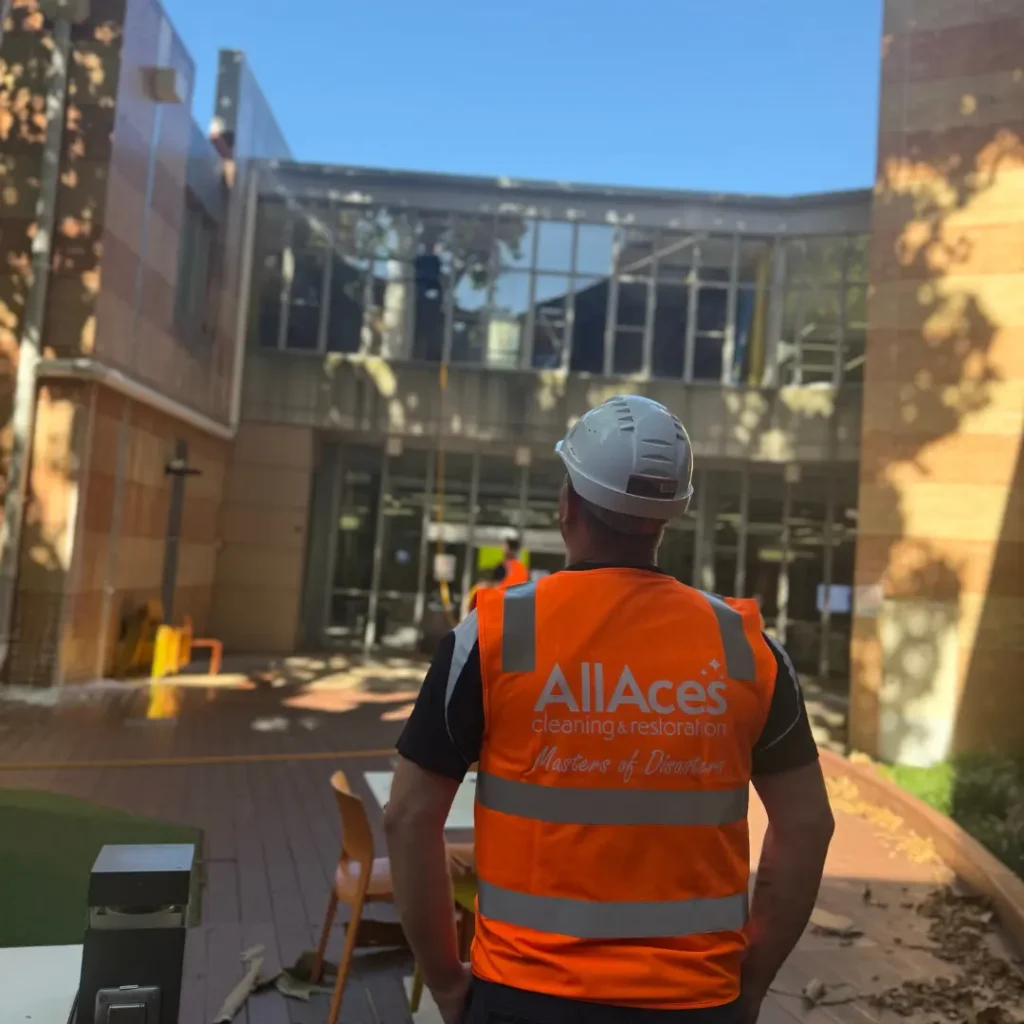
Pressure washing is the right tool for robust, non-porous, mechanically sound surfaces carrying inorganic soiling: concrete, unsealed pavers, brickwork, loading docks, industrial flooring. For anything organic (mould, lichen, algae) or anything fragile (render, paint, glazing seals, roof tiles), low pressure soft washing with an appropriate cleaning solution is usually the correct method.
Pressure gets marketed because it is the easiest thing to put a number on. Which is a shame, because on most Australian buildings it is the variable most likely to cost you money.
The pressure removes what you can see. The chemistry and the dwell time remove what makes it come back. Get that distinction wrong and you pay twice: once for the wash, once for the repaint.
This guide covers the four methods and what each is genuinely for, which surfaces tolerate what, the stormwater and water restriction rules that actually apply in Australia, where drone-assisted washing fits, and the questions that separate a competent contractor from a cheap one.
The counterintuitive part, up front. On organic growth, high pressure makes the problem come back faster. Lichen and mould have root-like structures into the substrate. Blasting off the visible growth leaves the biology in place and roughens the surface, giving spores more texture to settle into. The result is a clean surface that regrows more heavily than an untouched one.
Key Takeaways
- Most damage from pressure washing is caused by too much pressure, not too little. Render, painted timber, roof tile glaze, mortar joints and window seals all fail before the dirt does.
- Soft washing is usually the correct answer for anything organic. Low pressure plus the right dwell time kills mould, lichen and algae at the root, so the result lasts.
- The legal risk is usually the runoff, not the surface. Washwater carrying detergents, oils or sediment must not enter the stormwater system.
- In South Australia, breaches under the Environment Protection (Water Quality) Policy 2015 can attract fines, environment protection orders, or prosecution.
- Hosing a driveway and pressure washing a building are treated differently under water rules. Sydney Water permits high pressure cleaning of building structures and vehicles, but not cleaning paths and paved areas with water unless it is necessary for safety, health or emergency reasons.
- Anything above single-storey is a falls-risk job, governed by work health and safety duties rather than a ladder and good intentions.
- Drones are excellent for some jobs and wrong for others. They remove the fall risk. They do not replace mechanical contact on heavy soiling, and commercial operation sits under CASA rules.
What high pressure actually does to the wrong surface
Water finds the weakest bond and lifts it. You get a clean patch with a halo of blown coating around it, and now the job is a repaint.
If a contractor proposes a high pressure wand on render, ask what pressure and get the number in writing. Then ask for a test patch in an inconspicuous spot before they commit to the whole elevation.
Concrete tiles have a surface layer that does the waterproofing work. Strip it and the tile becomes porous, which means it holds water, grows more lichen than before, and adds weight to the roof.
The roof looks better for one season and worse for the next five. Soft washing is the appropriate method here in almost every case. Higher pressure is only defensible when the roof is being prepared for a new coating, and that is a repaint prep decision, not a cleaning decision.
Older brickwork has soft lime mortar and high pressure removes it. Then water gets behind the brick, and you have moved from a cleaning problem to a building-fabric problem.
Heritage and soft lime mortar means low pressure and chemistry. Test patch first, every time.
Directed pressure drives water past the seal. The damage shows up two weeks later as a stain on an internal wall, and nobody connects it to the wash.
Glass wants low pressure, and a pure water rinse if you want a spot-free finish.
High pressure raises the grain, tears out the soft spring wood, and leaves a furry surface that holds more dirt than it did before.
Decking and cladding want low pressure with a fan nozzle at distance, or a timber-specific cleaner. Never a turbo nozzle.
This is the one people find genuinely counterintuitive. Lichen and mould have root-like structures into the substrate, so blasting off the visible growth leaves the biology in place plus a roughened surface with more texture for spores to settle into.
Common belief: pressure cleans. Reality: pressure removes. Whether removal solves your problem depends entirely on what the deposit is and what is underneath it. For the mould case specifically, see our note on pressure washing for mould remediation.
The four methods compared
| Method | Best for | Not suitable for | Trade-offs |
|---|---|---|---|
| High pressure washing | Concrete, loading docks, car parks, unsealed pavers, industrial floors, heavy oil and gum removal | Render, paint, roof tiles, soft mortar, timber, sealed surfaces | Fast and effective on tough substrates. Damages anything fragile, and generates significant runoff to manage |
| Soft washing | Painted and rendered facades, roofs, cladding, signage, windows, anything with mould, lichen or algae | Heavy mechanical soiling such as tyre marks or built-up grease | Kills organic growth at the root so results last far longer. Slower, and requires correct chemistry and dwell control |
| Hot water and steam | Grease, oil, chewing gum, food-industry hard surfaces, hygiene-critical areas | Heat-sensitive coatings and some plastics | Breaks down fats and oils that cold water cannot shift. Higher equipment and fuel cost |
| Drone-assisted washing | High facades, roofs and structures where access is the dominant cost | Heavy soiling needing sustained mechanical contact, or confined and cluttered airspace | Removes the fall risk and the scaffold or EWP cost. Limited by payload, wind and CASA operating rules |
Most buildings need two of these on different elevations. A quote that names one method for an entire property has not assessed the property.

Surface by surface: what to ask for
- Concrete driveways, paths and car parks. High pressure is appropriate. A surface cleaner attachment rather than a wand, otherwise you get stripes. For oil staining, a degreaser with dwell time and hot water, plus a plan for the contaminated runoff.
- Rendered or painted facades. Soft wash. If a contractor proposes a high pressure wand on render, ask what pressure and get it in writing.
- Roofs. Soft wash for lichen and mould, almost always. Higher pressure only when the roof is being prepared for a coating that is being replaced anyway.
- Brick and stone. Depends on the mortar and the age. Test patch first. Heritage and soft lime mortar means low pressure and chemistry.
- Timber decking and cladding. Low pressure with a fan nozzle at distance, or a timber-specific cleaner. Never a turbo nozzle.
- Glass and windows. Low pressure, and a pure water rinse for a spot-free finish. Directed high pressure at seals is how you create an internal leak.
- Commercial kitchens and grease-exposed areas. Hot water or steam, with trade waste disposal arranged before the job starts.
- Signage and cladding panels. Soft wash. Panel joins and adhesive-mounted lettering do not survive pressure.
In practice, a good contractor does a test patch in an inconspicuous spot and shows you the result before committing to the whole elevation. If nobody offers that, ask for it.
Where the water goes: the compliance point most quotes ignore
Washwater carrying detergents, oils, sediment or chemical residue is a pollutant and must not be discharged to the stormwater system. Compliant routes are licensed liquid waste collection, sewer discharge under a trade waste agreement, an approved effluent scheme, or on-site recycling. On a commercial job, containment and disposal is a line item, not an afterthought.
Stormwater is for rain
NSW EPA’s guidance on stormwater management is blunt about the principle: the drain is just for rain. Other state regulators take the same position.
South Australia’s guidance for wash bays states the requirement directly: no washwater containing any cleaning agents or toxic pollutants should be discharged directly to the stormwater system. Under the Environment Protection (Water Quality) Policy 2015, breaches can result in fines, environment protection orders, or prosecution. The EPA SA wash bay guidance also sets out the compliant disposal routes and the pre-treatment expected before disposal.
The practical question to put to a contractor is short: how are you containing and disposing of the water? Answers that count are wastewater recovery equipment, bunding or berms, vacuum recovery, and a trade waste arrangement. The answer that should worry you is “it just runs off”.
Water restrictions treat surfaces differently to structures
This one surprises people. Under Sydney Water’s Water Wise Guidelines, cleaning hard surfaces such as paths, driveways, concrete or paved areas with water is not permitted unless necessary for safety, health or emergency reasons. High pressure water cleaning equipment may be used to wash building structures (windows, walls, gutters, roofing) and to clean vehicles, at any time. Hoses must have a trigger nozzle except when supplying high pressure equipment, and runoff or overspray onto hard surfaces is not allowed.
So the compliance question is not “is pressure washing allowed”. It is which surface, for what reason, and whether there is a genuine safety or health basis. A slip hazard from algae on a walkway, or contamination in a food-handling area, is a different case to cosmetic driveway cleaning. Rules differ by water authority and by current restriction level, so check your own.
Heights, and why the ladder is the real risk
Falls from height remain one of the most serious risk categories in Australian workplaces. Safe Work Australia’s model Code of Practice for managing the risk of falls at workplaces covers managing the risk of a fall from one level to another that is reasonably likely to cause injury, and applies to workplaces under the WHS Act and Regulations. Its legal effect depends on your state or territory regulator.
- Second storey and above changes the job. It needs a documented approach: elevated work platform, scaffold, rope access, ground-based extension poles, or a drone.
- A wet surface plus a reactive high pressure lance on a ladder is a bad combination. The recoil is the part people underestimate.
- Eliminating the need to work at height beats managing it. That is the strongest practical argument for soft washing from the ground and for drone-assisted work. Not the marketing argument, the risk-hierarchy argument.
- For commercial sites, ask for the safe work method statement, the public liability cover, and how pedestrian and vehicle traffic will be controlled. Barricades and signage on a wet trafficked surface are not optional extras.
Drone pressure washing: what it actually solves
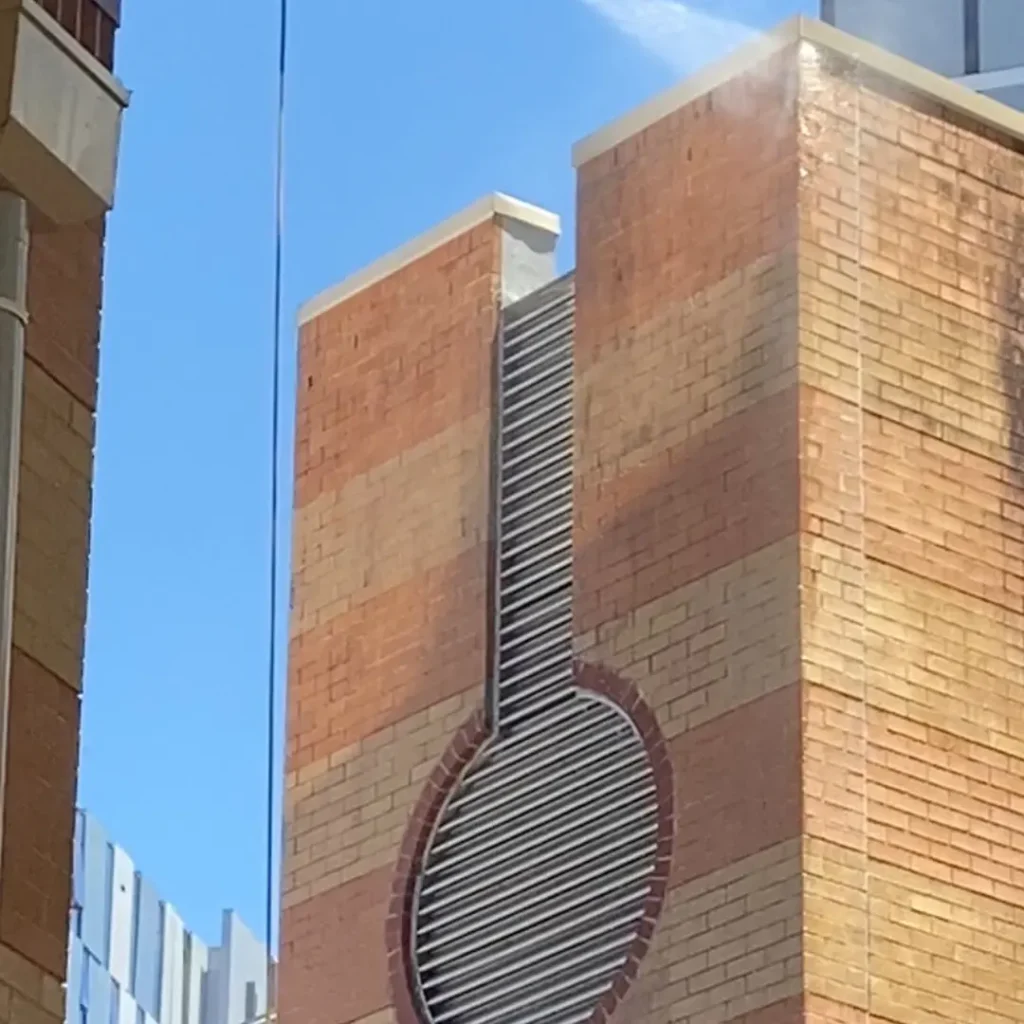
Drone-assisted washing removes the need to put a person at height, which eliminates a fall risk and often removes the cost of scaffold or an elevated work platform. It suits high facades, roofs and structures where access is the dominant cost. It is limited by payload, wind, water supply logistics and aviation rules, and it does not replace mechanical contact on heavily bonded soiling.
The honest assessment: it is a genuine access solution, not a universal cleaning method. It shines where the alternative is a week of scaffold hire. It struggles where a surface needs sustained close-range contact.
What it changes on a real job is the risk register and the access line of the quote, not the chemistry. The surface still decides whether the job is a high pressure job or a soft wash, and a drone can deliver either. On a four-storey rendered facade with lichen, the drone is carrying a soft wash solution, because that is what the render needs.
Commercial drone operation in Australia is regulated by the Civil Aviation Safety Authority, which sets registration, accreditation and licensing requirements plus operating rules around distance from people, airspace and visual line of sight. Anyone flying commercially should be able to name their credentials and approvals. Start at CASA’s drone information if you want to know what to ask.
Practical limits worth knowing before you specify it: wind cuts flying days, water has to be pumped up to the unit so there is a tether and a ground crew, and cluttered airspace or close neighbours can rule a site out entirely. See drone pressure washing for how we scope it.
What drives the price
Access
Ground level versus second storey versus roof. Scaffold, EWP or drone changes the number more than area does.
Method required
Soft washing takes longer than blasting, because dwell time is not negotiable. Slower is often the correct answer.
Containment and disposal
Recovery equipment and trade waste disposal are real line items on commercial jobs. A quote without them is either non-compliant or incomplete.
Soiling type and age
Fresh algae versus twenty years of lichen. Oil versus dust. Age decides how much dwell time and how many passes.
Surface fragility
Test patches, masking and careful low pressure work take time. That time is the cheapest insurance on the job.
Site conditions
Out-of-hours work for retail and hospitality, traffic management, pedestrian control, and whether there is a site tap and power.
Square metres are only one input, and often not the biggest one. For indicative service pricing see our pricing overview, then get a site-specific quote, because access dominates.
Common mistakes, in rough order of cost
- High pressure on a concrete tile roof. Often the most expensive mistake in this category, because the damage is not obvious until the roof starts holding water.
- Blasting render or painted weatherboard, which turns a wash into a repaint.
- Skipping the test patch, then discovering a coating is failing after the whole northern elevation is done.
- Letting washwater into a stormwater drain on a commercial site. Regulatory exposure, and a reputational problem if a neighbour reports it.
- Cosmetic driveway hosing under water restrictions. Check your water authority's rules before you book.
- Treating organic growth mechanically. It grows back heavier. Chemistry, not pressure.
- Specifying a drone because it sounds efficient, on a job that needs sustained mechanical contact. The access saving is real, the cleaning limits are too.
- Cleaning a mould problem without finding the moisture source. If a wall is wet because it is leaking, cleaning it is maintenance, not a fix.
On that last one: our complete guide to removing mould covers the underlying problem, and pressure washing for mould remediation covers where washing helps and where it does not.
How to choose a pressure washing contractor
- Ask what method they propose for each surface, and why. If everything gets the same answer, keep looking.
- Ask for a test patch before the full job.
- Ask what pressure they will use on your most fragile surface, and get the number in writing.
- Ask how washwater is contained and disposed of. Recovery equipment, bunding, trade waste. Specifically.
- Ask about water restrictions for your area and surface type. A contractor who does not know is a contractor who has not checked.
- Ask for the heights plan on anything above single-storey, plus the safe work method statement for commercial sites.
- If drone work is proposed, ask for the operator's CASA credentials and approvals, and what wind conditions will postpone the job.
- Confirm public liability insurance and the cover amount.
- Ask how they protect what is not being cleaned: plants, vehicles, signage, electrical, air intakes.
- Get a written scope listing surfaces, methods, exclusions and expected outcome. "Clean the building" is not a scope.
- Ask what the result will look like at six and twelve months. A soft wash contractor can answer this. A blast-and-go contractor usually changes the subject.
Why AllAces is worth considering
Method chosen per surface
Industrial high pressure equipment for concrete and robust brickwork, low pressure soft washing for painted facades, windows and signage. That distinction is the difference between a clean building and a repaint bill.
Water recovery as part of the job
Wastewater recovery systems used where required, to keep contaminated runoff out of stormwater drains and meet council and environmental obligations. On a commercial site, that is not a nice-to-have.
Drone access when it earns its place
For high facades and roofs where the alternative is scaffold hire, drone-assisted washing removes both the fall risk and the access cost. We scope it against the surface, not the novelty.
Restoration background
A team that spends its week on water damage, mould remediation and decontamination tends to ask why a wall is dirty before cleaning it. Sometimes the honest answer is that washing is the wrong service.
Bias declared: this guide sits on our own site. AllAces has worked across Australian restoration and specialist cleaning for more than 35 years, running commercial pressure washing across Queensland, New South Wales and Victoria. Related services: external house cleaning and washing for residential exteriors, graffiti removal where paint, ink or acid etching has to come off without damaging the substrate, and drone pressure washing for high-access work. Specialist profiles are published at Meet Our Experts.
Frequently asked questions
What pressure is safe for my house exterior?
There is no single safe number, because it depends on the substrate. As a working guide: concrete and unsealed masonry tolerate high pressure, while render, paint, timber and roof tiles do not and should be soft washed at low pressure with appropriate chemistry. The reliable method is a test patch in an inconspicuous area, then inspect before committing. Any contractor who names one pressure for an entire building has not assessed the building.
Is drone pressure washing better than scaffold or an EWP?
For access, often yes. A drone removes the need to put a person at height, which eliminates the fall risk and usually removes the scaffold or elevated work platform cost on high facades and roofs. For cleaning power, no. It cannot apply sustained mechanical contact, so heavily bonded soiling still needs a person or a different method. Wind, payload and CASA operating rules also limit when and where it can fly. Treat it as an access decision, not a cleaning upgrade.
Is pressure washing allowed under Australian water restrictions?
It depends on the surface and your water authority. Under Sydney Water’s Water Wise Guidelines, high pressure cleaning of building structures such as windows, walls, gutters and roofing is permitted at any time, while cleaning paths, driveways and paved areas with water is not permitted unless necessary for safety, health or emergency reasons. Rules vary by authority and by current restriction level, so check yours before booking cosmetic hard-surface cleaning.
Can pressure washing damage a roof?
Yes, and concrete tile roofs are the most common casualty. High pressure can strip the tile’s surface layer, leaving it porous. A porous tile holds water, gains weight, and often regrows lichen more heavily than before. For roof cleaning, soft washing is generally the appropriate method. Higher pressure is only defensible when the roof is being prepared for a new coating.
Does washwater have to be collected, or can it run off?
If it carries detergents, oils, sediment or chemical residue, it must not enter the stormwater system. EPA guidance in South Australia states that no washwater containing cleaning agents or toxic pollutants should be discharged directly to stormwater, with compliant routes being licensed liquid waste collection, sewer discharge under a trade waste agreement, approved effluent schemes, or recycling. On commercial sites, ask specifically how the contractor is containing and disposing of the water.
Is soft washing better than pressure washing?
Neither is universally better; they solve different problems. Soft washing is generally better for organic growth such as mould, lichen and algae, and for fragile surfaces such as render, paint, roofing and signage, because it kills the growth rather than just removing what is visible. High pressure is generally better for robust surfaces with heavy inorganic soiling, such as concrete car parks, loading docks and industrial floors. Most buildings need both, on different elevations.
The short version. Stop asking how much pressure a contractor uses. Start asking what method they will use on each surface, where the water goes, and how they plan to work above single-storey. Those three questions sort competent operators from cheap ones faster than any price comparison.
More on exterior cleaning. For the mould side, see pressure washing for mould remediation and the complete guide to removing mould.
Commercial pressure washing, external house cleaning and drone pressure washing across QLD, NSW and VIC. Call 1800 00 10 10.